06 May 2013

Israel and Palestine: Interesting Signs

Unless you found this humble soapbox through a misguided Google search, you already know where I stand on the dual Palestinian Kurdish peace processes. I already covered the latest developments on the Kurdish one.

There are signs that a major initiative is about to be launched in Israel.

A Symbolic Change

Let me start with a symbolically significant sign. Yesterday Google announced that it was changing the name Palestinian Territories to Palestine across its product line. So if you click on Google in Ramallah you will see this:

Why is that relevant?

Google is a giant multinational corporation. They don't take risky steps. Steps that can alienate large segments of their customers. If they did it, they must have researched it thoroughly.

And there was almost no reaction to it. Google it, you will see. Both Aljazeera and Jerusalem Post used the same canned piece (though JP couldn't help a provocative headline) and reported the same tepid reaction from a single Israeli official. Normally, you would get a solid Israeli reaction supported by US Congresspeople and  Senators repeating the same talking points. This time, nothing.

As for the non symbolic signs there are several and they are quite important.

Israel's First Referendum in 65 Years

First of all, a week ago, the Arab League made a public concession to Israel. Previously, a peace plan developed by Saudi King Abdullah called for the creation of a Palestinian state within the pre-1967 borders in exchange for all Arab countries recognizing the State of Israel. This time, they made it clear that they no longer insist on a complete withdrawal.
In Washington Monday, Qatari Prime Minister Sheik Hamad Bin Jassem Al Thani tried to allay some of the Israeli concerns. Speaking on behalf of an Arab League delegation, he reiterated the need to base an agreement between Israel and a future Palestine on the 1967 lines, but for the first time, he cited the possibility of "comparable," mutually agreed and "minor" land swaps between the Israelis and the Palestinians.
Note the central role played by Qatar in these arrangements once again. You can be certain that the change of heart was due to relentless US pressure. Qatar has been able to punch above its weight largely because it carries the US' water.

Tzipi Livni, the Israeli Minister of Justice (and the minister in charge of negotiating with Palestinians), reacted positively to the news. And she did so right away.

At first Netanyahu was silent.

Then, while meeting with the Swiss Minister of Foreign Affairs, he casually announced that he was going to call the first referendum in the 65 year history of Israel to let the people decide the outcome of the peace process.

Clearly, he was letting his coalition partner Naftali Bennett and the settler movement know that he was going ahead with the peace process. More importantly, he was warning them that he was not stupid enough to pull an Ariel Sharon and take on the settlers directly. He intends to commit Israeli people first and make it that much harder for the settlers to oppose it.
By pledging to put any deal to a referendum, Netanyahu could be hoping to avert any immediate far-right backlash to a decision to talk land-for-peace with the Palestinians, promising that the Israeli people would have the final word. 
"There is a very serious effort under way to get talks to resume," said a senior Israeli official who declined to be named. "People are devoting a lot of time and effort to this. It is possible and it is doable."
The following day, Livni flew to Washington to meet with Kerry to discuss the Arab League plan. Tellingly, she was accompanied by Netanyahu's special envoy Yitzhak Molcho (Molcho is a member of Netanyahu's inner circle and he has always been entrusted with sensitive missions).

Later in the day, she met with the UN Secretary General Ban Ki-Moon and afterwards, she told the media that she was optimistic about the process.

Taken collectively, these are significant signs.

Rapprochement With Turkey

While these diplomatic steps presage an upcoming announcement on the peace process, behind the scenes Israel has been working overtime to set up all the necessary elements for this to succeed. The most important is to make sure that Turkey is part of the process and on the side of Israel.

Israel has two trump cards to ensure this.

Energy

After Netanyahu's carefully drafted apology, an Israeli delegation went to Ankara to offer a major carrot to Turkey. The idea was to build a pipeline to Turkey to connect the natural gas reserves discovered in 2009 near Haifa. Tamar field is estimated to hold 10 trillion cubic feet of gas and it has just began producing 300 million cubic feet/day. There is also the nearby Leviathan field that is being developed with a 17 trillion cubic feet capacity.

Such a connection would provide Turkey with an important source of energy and would reduce its dependency on Russian and Iranian gas. Moreover, it is estimated that buying its natural gas from Israel would mean an annual savings of at least 1 billion dollars.

If the Leviathan field that will come online in 2017 is also connected to Turkey to reach European markets, the project would be a significant boost to Turkey's aspiration to become a major energy hub.

The Israeli gift is also significant for Turkey for another reason. The Tamar field is adjacent to the smaller Cyprus reserves. Previously Israel promised help to Cyprus in exploiting these fields. But in recent months, they distanced themselves from both Greece and Cyprus to focus their attention to Turkey instead.  Without Israeli involvement, Cyprus is unlikely to find the economies of scale to profit from these discoveries. Seen this way, Israel might have the right leverage to persuade Cyprus to adopt a more flexible stance towards its northern neighbor.

Syria

The second Israeli trump card concerns Syria. Both Turkey and Israel have a lot to loose if Syria were to become a failed state. It it vitally important for them to have a clear transition plan for post-Assad Syria. There are reports that Turkey and Israel have been conducting joint covert military operations inside Syria for some time. For instance, an American analyst made these remarks recently:
It has been obvious to everyone here that Turkey and Israel had been working in covert cooperation including during the time of their diplomatic breakup. 
Their aim is the destabilization of Syria and Iran. They are working with Georgia, Azerbaijan, the Arab states, working with NATO; there they have been involved.
Specifically, the two sides are interested in limiting the influence of Jihadis in FSA and in ensuring that the stockpile of chemical weapons do not fall into the wrong hands. As you can imagine Turkey has a larger role on the former and Israel is focusing on the latter.

In all this, what is interesting is how these two peace processes are intertwined. It is a highly complicated chess game played on a large board.

But I still think that they will happen and we will soon see a Kurdistan and a Palestine.

04 May 2013

Francois Hollande's First Anniversary

France is not doing well.

And François Hollande is not doing well at all. His popularity rating is hovering around 25 percent, an all time low.

Former president Sarkozy's pop star wife Carla Bruni has recently written a song entitled le Pingouin (the penguin  making fun of him for being indecisive (Mr Neither yes nor no is his nickname) and for being utterly ordinary:
'Neither ugly, nor beautiful, neither tall nor short, neither cold nor hot, the penguin, neither yes nor no.
(For the actual French lyrics, click here)

"The Penguin"

After Nicolas Sarkozy, who was dubbed the "bling-bling president" for his high-roller friends, his glamorous wife and his appetite for the good life, Hollande is quite simply boring. He is known as Mr. Ordinary. Coloring his hair is about the only vain thing about him and even there he seems to be relying on a supermarket jar rather than the elaborate efforts of a high end coiffeur.

"The Penguin" and "the Rottweiler"
But Mr. Ordinary's presidency is not going smoothly and it is certainly not as low key as his appearance. Early on, he had a minor scandal caused by his girl friend Valerie Trierweiler. She tweeted her support for the candidate running against Hollande's former partner and the mother of his three children, Segolene Royale. Royale lost the election and Hollande looked well, weak. Most people thought he should have stopped her.

In the highly macho culture of France, having an affair is nothing but having an outspoken female partner could be a major problem.

She was quickly dubbed the Rottweiler and the tabloid press began to publish many colorful inside stories about how bossy and difficult she was.

Then, as he was vacillating about various tax positions (and being put on the defensive by Gerard Depardieu's very public departure), a major scandal erupted. This time it was his budget minister Jerome Cahuzac (a former plastic surgeon) who confessed to having a Swiss bank account with 600,000 euro in it. The bad part is that his confession came after months of very public denials (think about several highly rated "I never had sex with that woman" TV moments). And when he eventually admitted his wrongdoing, his vociferous denials made whole thing doubly damaging for Hollande and his government. It looked like a good example of elite hypocrisy: while they were arguing for the need to increase taxes, they were placing their own money away from the state's grubby little hands. And this was his budget minister.

As unemployment rose (it did for 23 straight months to reach an all time high in March) and the economic figures got worsened, Hollande opted to focus on gay marriage. While the majority of the electorate support the notion (and it was a campaign pledge of his), the opposition sensed that this was a perfect issue to launch an attack against him. Led by the Catholic church (which is becoming a significant force in France, as religion is reclaiming its pre-modernity position all over the world), opposition parties managed to organize several unexpectedly large rallies and challenged him openly. Since he had the votes, the law was passed by the AssemblĂ©e Nationale but it felt less of a victory and more of an unnecessarily bruising fight.

Hollande tried to salvage this situation by going after the Jihadis in Mali. French forces swept the country quickly and that led to a brief moment of national pride (maybe even some colonial nostalgia). But given the woeful economic situation, people rapidly began to question the wisdom of undertaking costly military campaigns in Africa.

Mali notwithstanding, French foreign policy seemed to be in disarray. The most damaging was a perceived loss of voice  in European affairs. As the largest and the second largest economies of the EU, Germany and France had always dominated the European debate. People thought that Franco-German alliance was the backbone of the Union. Most of the EU institutions were created after the French model and France has always been a very important player in them. Apparently, not anymore:
"You can see a shrinking presence, a progressive disappearance of France on most issues that concern the economic agenda," said Fredrik Erixon, director of the European Centre for International Political Economy, a Brussels think tank. 
European diplomats from a range of member states, speaking on condition of anonymity, are more blunt. 
"You don't hear France's voice at all. They are nowhere, just nowhere," said a senior European diplomat who is in frequent contact with other member states.
Given Sarkozy's high profile presence with Angela Merkel (she openly supported him for his reelection bid), this shrinking presence is directly attributed to Hollande's ineptitude.

Besides dismal foreign policy, the economic picture is also getting darker with each passing month. Yesterday, the European Union released a new report. It indicated that France is going to slide into recession this year and the next and unemployment will continue to rise through 2014. Since France is supposed to meet the EU budget requirements (reducing deficit to within 3 percent of output) in 2014, it is not possible for Hollande to undertake vigorous stimulus spending. French debt is too high and there is no willingness to move funds from one spending area to another. (Despite contradictory announcements he only froze the defense budget but did not actually reduce it).

In short, the year ahead looks rather grim for Francois Hollande. To put salt to his wounds, his nemesis Nicolas Sarkozy is now very popular in opinion polls and  if elections were held today, he would handily trounce Hollande.

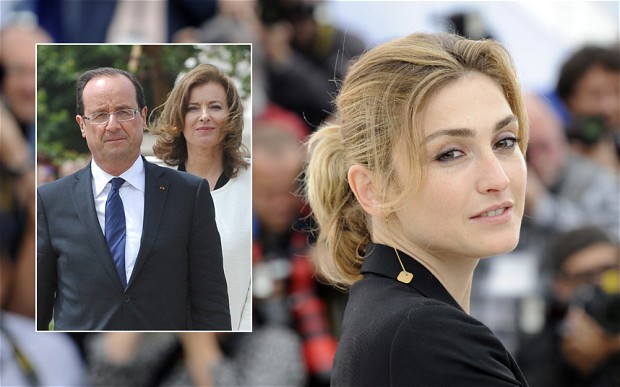
Given that overall somber picture, I was not surprised to see social media rumors about Hollande having an affair with Julie Gayet, a wistful looking 40 year old actress who had some modest fame in the 90s.

What better way to brush up your ordinary image than getting social media make lurid allegation about your virility? Forget about being indecisive. Forget being controlled by a domineering girl friend. He was seen outside her apartment. Forget the penguin, the man is a hound dog!

I had many French friends telling me that they heard it from very well placed sources that the affair was for real. Sure, I said. French people maintain their innocence when it comes to PR coups and viral marketing campaigns through social media. I am a tad more cynical. Maybe there is something to the rumors, maybe there is not. But it is almost certain that the idea of an affair was made public for a PR reason.

And it worked somewhat. After an initial reaction of "how does he find the time?" and "where is Valerie?" these rumors seems to have given him some boost in the public's esteem. I don't think it will last but it might somewhat alter his image of an ineffectual penguin.

Only in France can a politician hope to recover lost ground by starting rumors about an illicit liaison.

Vive la France, indeed.

30 April 2013

Turkey and Shanghai Five

A couple of months ago, I posted a piece about Turkey's seemingly inexorable drift towards Asia, citing the Prime Minister Erdogan's public declarations to join the Shanghai Cooperation Organization (SCO), known as Shanghai Five.

As you might know, the SCO was formed by China and Russia and has Kazakhstan, Kyrgyzstan, Uzbekistan and Tajikistan as its members.

A couple of days ago, Turkish Foreign Minister Ahmet Davutoglu signed a memorandum of understanding with SCO for Turkey to become a dialogue partner of the organization.
"This is really a historic day for us," Turkish Foreign Minister Ahmet Davutoglu said in Kazakhstan's commercial capital Almaty after signing a memorandum of understanding with Shanghai Cooperation Organisation Secretary General Dmitry Mezentsev. 
"Now, with this choice, Turkey is declaring that our destiny is the same as the destiny of the Shanghai Cooperation Organisation (SCO) countries."
To be sure, in and of itself this is not a big deal, as dialogue partner status is below that of observer status that was previously given to India, Pakistan, Iran and Afghanistan. But in his speech, Davutoglu claimed that it was the beginning of a deeper process of cooperation.
"I hope at the next summit in (the Kyrgyz capital) Bishkek we will be present, as well as at ministerial meetings," Davutoglu said. "This is the beginning of a long way, walking together, hand in hand and shoulder to shoulder."
It is possible to see this move as just a symbolic rebuke directed at the European Union. But I think there is more to it than the desire to send a signal to EU officials and European leaders.

As Turkey is part of the European Customs Union, it is already benefiting from the free trade advantages offered by EU. Formally joining the union would not bring much additional benefits. In fact, it would make life more difficult for its industries by subjecting them to stringent environmental and social regulations.

By opening up to Asia (while maintaining its ties to EU) Turkey is betting that it could become a true bridge between the two continents. With the proposed high speed train to connect China to Europe, Turkey hopes to become a major conduit between East and West. They also believe that their strategic goal of becoming an energy hub, supplying Europe with natural gas and oil through an extensive network of Central Asian and Middle Eastern pipelines would enhance that position.

One other interesting aspect of this Asia policy is to hedge Turkey's military bets as well. There are hints that SCO could become a larger security organization to counterbalance NATO. If that were to materialize, as a NATO member Turkey could find itself in a unique position.

In short, I can't see much of a downside in all that for Turkey. Actively pursuing a rapprochement with the Shanghai Five is a win-win proposition for them.

But if I were a European politician I would pay closer attention to the evolution of that relationship.

28 April 2013

The PKK Strategy Involving Turkey, Iran and Syria

If you have been reading this humble blog since its inception you might know that my starting hypothesis was the inevitability of a larger peace process in the Middle East that would solve the Kurdish and Palestinian issues.

Recently, a good friend of mine told me that, until a couple of days ago, she thought that my working hypothesis was, well, let's use the term loopy to be charitable to the resident contrarian. She did not think that peace between Kurds and Turkey would happen in my life time. And don't let me get started about Israel and Palestinians.

I understand her reaction perfectly. It is shared by almost everyone I know. The daily stuff coming out of Middle East is mostly sound and fury. If you try to absorb it all you'll end up with the impression that these tales are told by Shakespearean idiots. While that might fit the bard's metaphor, these regional actors are far from being stupid. They might appear crazy but they are actually crazy like a fox.

Of all the actors in the region, I find the PKK the most fascinating. They managed to pursue (rather successfully) an armed struggle against the mighty Turkish army for three decades. They remained a thorn on Turkey's side and on the side of most of its neighbors. They formed ever changing alliances to play one country against another only to change sides rapidly when the winds shifted direction.

In short, they are as astute a player as anyone has seen in that region.

As you might know, a comprehensive peace plan is being negotiated by Turkey and the PKK (hence my friend's change of heart about my hypothesis). After three decades of mutual animosity the two sides are joined as partners in a historic process.

Mural Karayilan
A couple of days ago, Murat Karayilan, the acting leader of the PKK, announced that his organization is withdrawing from Turkey. This was something most people doubted even a few days earlier. The PKK would never acquiesce to such demands, they claimed.

Well, they did. And there is a reason for this as I will explain in a minute.

The peace plan itself is fairly simple:
  • Gradual withdrawal of PKK forces from Turkish soil
  • Constitutional amendments made by Turkish government
  • PKK completely lays down arms once Ocalan and other Kurdish militants released from prison
The timing is very good since currently the Turkish government is drafting a new constitution and if the peace process is not disrupted prematurely, one or more of the civilian offshoots of the PKK are likely to be integrated into the process.

I concur that normally, the PKK would not have withdrawn from Turkey and easily given up its most potent trump card in these negotiations. My thinking is that, they did so because they have better and bigger trump cards up their sleeves.

As I wrote before, the PKK has two satellite organizations in Iran and Syria, the PJAK and PYD respectively. The PKK created them in 2003 and have been using them to form temporary alliances with different players at critical junctures.

For instance, in 2011, Murat Karayilan announced that the PJAK was going to stop fighting against the Islamic Republic of Iran. His rationale:
"We don’t want to fight against the Islamic Republic of Iran. Why? Because the goal of the international powers that want to redesign the region is to encircle Iran. Nowadays, they are more preoccupied with Syria. When they are done with that, it will be Iran’s turn. At such a phase, as Kurds, we don’t think being at war with Iran is appropriate." 
And just like that, they abandoned their Iranian Kurdish brothers and sisters and sided with Tehran. Ostensibly, this enabled them to shift their resources to Turkey and to escalate their armed struggle there. But actually, the move was sponsored by Iran to make life difficult for Turkey and to curb this latter's aspirations to become a regional super power. And the PKK played along happily.

Now that the PKK is negotiating with the Turkish government for a permanent solution, there are signs that the PJAK is reacquiring arms in Iran and getting ready to fight against the Islamic Republic.

Two op ed pieces appeared on 10 and 11 April in a Turkish daily (Radikal) penned by Aysel Tugluk, a veteran Kurdish activist and an independent member of parliament from the eastern city of Van. In the first one she hailed the peace process as "a road of no return" and a historic opportunity. A once in a century opening, she said.

In the second piece she contemplated the future implications of the peace process:
Aysel Tugluk
"At this point, we are faced with the vital question: All is fine, but what will happen to the PKK? At least in the next quarter century, the PKK will be around one way or the other, wherever there are Kurds. This could be armed for a while in Syria, re-armed again in Iran in the near future and institutional in Europe. The PKK will be in Turkey in various shapes with its programs, ideas and political and social institutions in its areas of influence and democratic activities. But in [Abdullah] Ocalan’s vision of the near future, there is an irreversibly movement of the PKK’s armed forces out of Turkey’s political areas.” [emphasis mine]
Tugluk is an important figure within the Kurdish movement and her public ruminations carry a lot of weight. It is also rather telling that the suggestion was made not by the military wing of the PKK (i.e. Karayilan) but by a human rights activist.

Right after this op ed, PJAK called upon Iranian Kurdish groups to form a unified plan of action against Iran. Not surprisingly, the PJAK's call got a frosty receptions from the other Iranian Kurdish organizations largely because of their previous move to ally themselves with Tehran against Turkey. But I am confident that eventually the PKK's formidable resources and fighting apparatus will convince the other Kurdish groups to form an alliance with them. And if the PJAK became once again a major headache for Tehran, this would make the PKK a very important actor for Washington and Ankara.

There is also the Syrian situation mentioned by Tugluk.

As I suggested many times, Kurds hold the key to the Syrian conflict.

The PYD resisted until recently to fight against Damascus, claiming that this served Kurdish purposes better. But now that they signed up with other Kurdish groups and with the peace process in Turkey rapidly evolving, they are likely to get the signal to join the effort to topple Bashar and Co.

If that happens, their presence would change the current military equation. Right now there is a war of attrition with two exhausted armies in a situation of stalemate. The entry of a reasonably well equipped and well trained fighting force is likely to disrupt the current balance of power.

Secondly, their involvement would also signal a different balance of power within the Free Syrian Army.  Right now, Turkey, Israel and the US are worried that all the major fighting batallions consist of Salafist or Jihadi groups.
 Across Syria, rebel-held areas are dotted with Islamic courts staffed by lawyers and clerics, and by fighting brigades led by extremists. Even the Supreme Military Council, the umbrella rebel organization whose formation the West had hoped would sideline radical groups, is stocked with commanders who want to infuse Islamic law into a future Syrian government.
Nowhere in rebel-controlled Syria is there a secular fighting force to speak of.
This is why even reports of possible chemical weapon use by the Syrian army were not enough to encourage the US or Turkey to supply the rebels with better arms.

Unlike the Jihadis that make up the bulk of the FSA, Kurds are staunchly secular. If they join the fight, they will provide a much needed counterweight against entities like the Al Nusra Front whose leaders recently swore allegiance to Al Qaeda. In fact, these guys went so far that even Syrian Islamists denounced the Al Nusra Front and its foreign fighters.

But currently no one can contain them and these Jihadis are moving to control critical assets and strategic areas. They plan to become the dominant group in post-Assad Syria. A Kurdish entry might disrupt these plans and change the make-up of the post-Assad system. Their presence would also reassure Alewites, Christians and other non-Sunni minorities who view (rightly) these Jihadis with deep suspicion.

In short, through its satellite organizations and its formidable military apparatus, the PKK is about to transform itself into a kingmaker in the region. Essentially, its actions could make or break the US (and by extension Turkish) plans.

And that gives them all the bargaining power they need.

27 April 2013

Debt and Austerity Debate and the Reinhart-Rogoff Debacle

If you are a wonkish person like me, you might be aware of a recent scandal that shook the unsavory school of thought I call neo-classical economics.

You see, two Harvard professors, Carmen Reinhart and Kenneth Rogoff published a seminal paper in 2010 to establish that there was a causal link between slow growth and indebtedness. They specifically claimed that once the debt to GDP ratio reaches 90 percent, growth actually slows down. Since both debt and growth are expressed as a percentage of GDP, one could always argue the causality in either direction: lower growth leads to higher debt vs higher debt leads to lower growth.

Theirs was the first argument in favor of a unidirectional causality. And the first one to determine a tipping point. Their work become the foundation for all the conservative demands to dismantle the social safety net and to cut government spending in order to reduce debt. At long last, here was the justification for what they have been clamoring. It was Pete Peterson's wet dream.

As a result, their work was quoted countless times in the austerity debate. Rogoff has written many op eds with strong policy conclusions encouraging spending cuts and austerity measures. His testimony before the Senate created a rare bipartisan moment of consensus about the terrible toll of high public debt.

Their reach and influence was extraordinary. Their conclusions were cited by European Commissioner Olli Rehn, by Romney's running mate Paul Ryan, by (then) Treasury Secretary Tim Geithner, by Lord Lamont, former Chancellor and adviser to the current Chancellor of the Exchequer George Osborne.

Before Reinhart and Rogoff, there was only one lonely voice, another Harvard economist, Alberto Alesina, who claimed that austerity measures lead to growth. Sadly for him and the proponents of austerity, his work was demolished and repudiated rather quickly by mainstream economists.

So when Reinhart and Rogoff emerged they became critically important in determining the outcome of the austerity debate.

There was a tiny problem. No one could reproduce their results. Many tried and failed. So their peers asked to review their data but Reinhart and Rogoff simply refused.

Fast forward to this year. A couple of professors at the University of Massachusetts at Amherst gave a special assignment to their graduate students. They were each supposed to reproduce the findings of a famous paper. When Thomas Herndon, the graduate student who picked the Reinhart Rogoff paper could not duplicate their results, he wrote to Reinhart and Rogoff, to ask for their data. Since he was a lowly graduate student, they agreed to share their spreadsheets with him.

Herndon discovered that their data contained several very significant errors. Like omitting five countries by mistake. Or assigning the same value to one bad year in New Zealand to 20 good years in Britain. Or simply excluding certain cases that did not fit with their conclusions.

Consequently, when Herndon and his two professors published their findings with corrected data, their conclusions were quite different:
They find "the average real GDP growth rate for countries carrying a public debt-to-GDP ratio of over 90 percent is actually 2.2 percent, not -0.1 percent as [Reinhart-Rogoff claim]."
In other words, there was no tipping point and there was no unidirectional causality between high debt and reduced growth. In fact, other researchers discovered that there was strong evidence that the causality is reverse, i.e. low growth leads to higher debt.

What did the two neo-classical economists say?
"We are grateful to Herndon et al. for the careful attention to our original Growth in a Time of Debt AER paper and for pointing out an important correction to Figure 2 of that paper. It is sobering that such an error slipped into one of our papers despite our best efforts to be consistently careful. We will redouble our efforts to avoid such errors in the future. We do not, however, believe this regrettable slip affects in any significant way the central message of the paper or that in our subsequent work."
So an error that revises their conclusion from -0.1 percent to +2.2 percent is not relevant and does not change their central message.

Economics is a serious and respectable discipline. But neo-classical economics is an ideologically biased school, based on dubious axioms and sporting a fake scientific veneer.

And neo-classical economist never ever acknowledge that they were wrong. Ask Krugman how they destroyed valid Keynesian notions to replace them with bogus monetarist talking points.


20 April 2013

A Simple Point on Margaret Thatcher

You might have heard that some people danced in the streets to celebrate the passing of Margaret Thatcher. Others set up special twitter accounts, like #nowthatchersdead (thereby confusing Cher's fans). There was even a campaign to get the 1940's Wizard of Oz song, "Ding Dong the Witch is Dead" (which narrowly failed to get to the No 1 spot).

Thatcher 2012
All of this led to a debate about whether it is OK to dance on someone's grave.

The majority of observers felt that it was in poor taste to celebrate the passing of a frail old woman suffering from dementia. A smaller group of people argued that it was perfectly acceptable to debate the record of public figures at the end of their lives. And they believed that if that record largely consisted of divisive and harsh policies, it was a commentator's duty to say so with brutal honesty.

I can see the point for each position. But I am not interested in moralistic arguments.

I just want to make a simple observation about gender.

For that let me compare her record with that of her fellow conservative Ronald Reagan.

Thatcher's Legacy

Margaret Thatcher set out to destroy the trade unions as she she saw them as a destructive economic force. She did not see the relevance of trade unions in resisting income inequality. While trade unions can be unreasonable and make life difficult for everyone with their only weapon (strikes), they also play a very important role in economic regulation. They resist income inequality and by forcing businesses to pay more for labor they increase the purchasing power within the domestic market.

The Post-War bargain was to keep a balance between union wages and business profits. This worked as long as the world economy consisted of the US and Europe. Within that Keynesian model, businesses did not see the need to invest to increase productivity and this proved to be a huge mistake on their part. When Japan rose in the early 70s to compete with the US and Europe, these companies were caught off guard. Rising oil prices did not help as their relatively old production systems were not energy efficient (the same oil shock did not affect Japan's industrial output).

Unions did not understand the problem and continue to ask for more wages. Businesses did not understand the problem and focused on high wages as the reason for their inability to compete with Japanese goods. After several years of stalemate (and a funny economic period known as stagflation), the Tories came to power to apply the solution favored by the business side, namely wage reduction.

How do you achieve that? By going after the unions forcefully and relentless. She refused even their reasonable demands to force them into prolonged strikes and eventually economic bankruptcy.

As part of the same formula, she sold off profitable state-owned enterprises. The privatization wave served two purposes: one was to get rid of unionized workers and the other was to transfer wealth from the public sector to the private sector at a minimal cost.  The companies they sold off were (a) natural monopolies like water, gas and electricity, (b) industries that modernized themselves in recent years prior to privatization, like the British Steel (c) former monopolies who investment in infrastructure could never be profitably duplicated by competitors, like British Telecom or British Airways. 

For the business side, her government led to huge profits, much lower taxes, the rise of a gigantic finance sector (dual effect of deregulation and the need to raise large sums during the privatization process) and a formidable power position.

For the labor side, the end result was decline in union membership, loss of bargaining power, high unemployment, two recessions and rising income inequality.

Normally, it is not easy to implement such policies and expect to be reelected. But she did it by using a tried and true formula: when facing a recession and dismal ratings, go start a war. It increases public spending dramatically and it forces everyone to rally around you in a wave of patriotism.

She defended a tiny piece of rock near Argentina and the rest is history.

Ronald Reagan's Legacy

In the US, her biggest admirer and self-described partner Ronald Reagan implemented exactly the same policies at around the same time.

He destroyed the unions (in 2012, the unionized workers in the private sector constitute only 6.6% of the workforce). He reversed income inequality dramatically. His budget cuts led to a severe economic downturn that was dubbed Reagan's recession. His first term is marked by double digit unemployment in most of the United States.

Reagan tried hard to find companies to privatize but the US did not have a comparable economic asset density. So instead, he began the outsourcing revolution, that is contracting out public sector jobs to private companies. As with the Thatcher revolution this served the same dual purpose of cutting unionized public sector jobs and transferring wealth from public sector to private sector.

Like Thatcher, Reagan was also big on deregulation. He started the deregulation process in the natural gas, railroad, banking and telecommunication sectors. In fact, the starting of the infamous 2008 crisis is not the repeal of the Glass-Steagall Act but the Garn-St. Germain Depository Institutions Act passed under Reagan. This removed restrictions on loan-to-values for Savings and Loans and it encouraged banks to make very risky real estate investments (resulting in the first S&L bailout). If that sounds familiar, it's because it is a smaller version of the later crisis.

He also lowered taxes significantly for the upper brackets. They were as high as 70% when he came to power. He first lowered them to 50%. Then, in 1986 he lowered them to 28% while increasing the lowest brackets from 11% to 15%. In other words, he took from the poor and gave to the rich.

As a direct result of his policies, the US is now one of the worst countries in terms of income inequalities. Its middle class is shrinking towards oblivion. Its corporate executives became so greedy that they nearly destroyed the global economy for their personal enrichment.

And one last similarity: When his policies proved unpopular during his first term (just like Thatcher's) what did he do to? Well he invaded Grenada.

This led to increased spending (and massive borrowing) and a swell of patriotic pride. Grenada not being sufficient, he kept it up by escalating the Cold War.

Two Historic Figures at Their Death

When Reagan died (also suffering from Alzheimer's by the way) you could not believe the eulogies. Even his worst critics acted as if they were grudgingly conceding the man's massive contributions. He was credited with the productivity revolution, the end of Cold War and a large boom period.

Actually, none of these can be directly attributed to his policies. But nevertheless the man was lionized at his death. He was celebrated as one of the greatest presidents who made the US a better place.

Far from being named a divisive and hated figure he was promoted to patron saint of the GOP status. You cannot get past a GOP primary without declaring your undying admiration for and your strict allegiance to him.

So we have two politicians who followed the exact same path, implemented the exact same policies, in fact, pointed at each other as their muse and mentor.

When one of them died she became the Wicked Witch of the West.

When the other died he was canonized as St Ronnie.

Can you tell me how to explain this?

And can you tell me that there is no misogyny in that?

17 April 2013

The Gatekeepers: A Documentary

A good friend of mine sent me an email to remind me that I should watch the Gatekeepers, the celebrated Israeli documentary that brought together six former Shin Bet directors to comment on the Palestinian issue.

I knew of the documentary, as it was shown last year in Israel in the Jerusalem Film Festival. This is the world wide release by Sony Pictures Classics. Interestingly, its release became a news media event: it was reported by all the major news outlets (to see more media links just Google it).

What is extraordinary about the film is the fact that these Shin Bet chiefs are incredibly outspoken in their criticism of the State of Israel and the control it exerts over its Palestinian population. One of them, Avraham Shalom tells the director, Dror Moreh, that Israel has become a brutal occupation army.

And this man is no shrinking violet. He once ordered the extrajudicial killing of two Palestinian bus hijackers (and had to be pardoned by his political masters). So when this man compares Israel to, well, Germany you are a little taken aback.  Even though I am not Jewish I admit I winced when I heard that.

He explained that he was not talking about the Holocaust but the occupation of Holland, Belgium, Poland and many other Eastern European countries. But still. And that is the point, apparently. To make you stop and think and take notice.

If you think this is blunt talk, take a look at this: towards the end of the film the director reads the following quote from Professor Yeshayahu Leibowitz:
“A state ruling over a hostile population of one million people will necessarily become a Shin Bet state, with all that this implies for education, freedom of speech and thought and democracy. The corruption found in any colonial regime will affix itself to the State of Israel. The administration will have to suppress an uprising on the one hand and acquire Quislings, or Arab traitors, on the other.”
Professor Leibowitz made this pronouncement in 1968, one year after Israel occupied West Bank and Gaza.
The director asks Yuval Diskin, who was the Director of Shin Bet at the time, what he thought of this prescient quote.

He replies "I agree with every word of it."

When probed to expand, he shrugs as if the whole thing is really obvious and he could not see the need for further explanation. When pressed, he offers somewhat reluctantly that he is not entirely sure about a Shin Bet state but for the rest, he says, the quote reflects accurately the relations between Israel and Palestinians.

I cannot think of any other country in the world where the current or former director of a security agency could make such a pronouncement. It is simply extraordinary. And there is a reason for that.

There is a separation between Israeli and Jewish identities that most people cannot understand. That is partly because of the corrosive influence of pervasive antisemitic discourses. Many people, even the ones who do not think of themselves as antisemitic, espouse some of the most common prejudices about Jews. The gamut runs from "them being good with money" to "them supporting anything the State of Israel does."

This is rubbish. (And one of these days I intend to write about this in some detail but for now feel free to take my word for it)

Overwhelmingly, Jews in diaspora (a) are liberal (b) emphasize education over everything else, including money (c) support social equality and progressive causes and (d) are quite critical of the State of Israel.

Now, for this latter, they might not engage in such criticism in front of gentiles because they know that, for most of them, Jewish and Israeli are interchangeable and if they say something bad about Israel, next thing they know, their gentile friends will be using that comment to make frightening generalizations about Jews.

Israelis do not conform to that diaspora profile. They are tough, very direct and they are a product of a nation state. Every nation state has its its roots in violence. In Israel it is more so because of the circumstances surrounding its creation. In that sense, like there are many conservative French or Americans who advocate tougher policies, harsher penalties, stricter rules and unequal and discriminatory practices, there are many conservative Israelis who support these notions. That is because, like their French or American counterparts, they never found themselves at the other end of these equations.

This is known as the "empathy gap," a term coined by Nigerian-American writer Teju Cole and picked up by Glenn Greenwald.

Jews in diaspora, on the other hand, do not have that empathy gap, as they have been on the wrong end of that arrangement far too many times.

The Shin Bet directors in this documentary represent that point of view. They speak like Jews not Israelis. That is why Ami Ayalon says that if, according to von Clausewitz, "victory is the capacity to create a better political reality" then "we lost the war even though we won all the battles."

The worry is that if the next directors of Shin Bet have the Israeli perspective (instead of the Jewish one) they might redefine victory as suppressing and oppressing that large population under their control. That would be what a French or American national would do and that would be expected.

In the case of Israel, that would mean the end of the Jewish identity and that would be a very sad thing indeed.

--------------------------

I should finish here but I am tempted to add one last thing. When I started this blog two years ago, one of my hypotheses was the likelihood (or even the certainty) of an Israeli - Palestinian peace process.

I offered three arguments in my favor. One of them was the fact that 40 prominent Israelis and chief among them former directors of Mossad and Shin Bet prepared a peace plan and submitted to King Bibi.

That was on 25 May 2011.

The movie that was just released had started production around that time.

And it was released to a global audience right after the Israeli elections. Maybe it is just coincidence.

Or maybe, just maybe, it is Zeitgeist.