A good friend of mine asked me what I thought of the sectarian violence in Syria and why I was not commenting on the upcoming Geneva II talks.
I told him that both of these issues are closely linked and they were intelligible only if you looked at the larger picture. I added that there was a very complicated chess game that was being played out and it was hard to make pronouncements without looking foolish in the short run.
He retorted that looking stupid never stopped me before.
And besides, he said, nobody is reading this thing, what do you care?
I have devoted friends.
Let me start with the sectarian violence. In the past, I expressed concern about a prolonged civil war and the radicalization that this would bring to the parties. Over the last few months, I have come to realize that the sectarian violence is a feature not a bug.
What do I mean by that?
Think about the recent horrific video clip that showed the leader of the Omar al-Farouk Brigade killing a Syrian soldier and opening up his chest to bite into what he thought was his heart (it was his lungs apparently). What is unusual about it, is not the unspeakable act he committed. Humanity being what it is, in every war, countless acts of unspeakable barbarity have always been committed.
What is odd is that (a) this Jihadi filmed himself killing that guy and opening up his chest and biting into his organs (b) uploaded the video to You Tube and social media sites (c) took questions from a Time Magazine reporter to acknowledge that he was indeed the guy in the clip (d) volunteered the information that he had recently killed a shabiha militant and cut him up into small pieces with a chain saw. And he said gleefully that he was planning to upload that clip soon.
The clincher: At the end of the interview, he announced that he and his Sunni brothers would do the same to every Alewite in Syria.
A couple of days later another clip appeared on You Tube showing al-Nusra Front militants killing 11 Syrian soldiers.
There was also the (rather credible) allegation that the rebels have used sarin gas. And while "interested" parties cast doubt on that notion, rebels did not lift a finger to dispel it.
Since then, there was another incident every other day, the last being a couple of days ago, with Al Nusra Front rebels butchering 60 people in a Shia village.
The UN has just released a report that states that 93,000 people died in the civil war.
I have seen similar behavior during the Bosnian civil war and the goal was to ensure that any goodwill or any trace of trust among various communities was permanently erased.
It is ethnic cleansing through You Tube.
A prolonged civil war, increasingly radicalized and polarized community groups and the dissemination of barbaric acts collectively ensure that Geneva II or not (and Assad II or not), at the end of hostilities, Syrians will no longer be willing to live side by side in the same political entity.
And that too is a feature and not a bug.
Let me try to explain why that is the case.
Pipelineistan
The term was coined by the brilliant Pepe Escobar and it is a fairly apt description of the process of re-arranging the political geography of the region.
Let's take a look at the actors and their stakes.
Qatar
Qatar is a tiny country in the Persian Gulf. Its most important attribute is to be sitting on top of the largest natural gas fields in the world, the South Pars/North Dome Field. The field is estimated to hold 51 trillion cubic meters of natural gas (that's trillion) and 50 billion barrels of natural gas condensates.
What complicates things is that Qatar is not the sole owner of the field. It shares it with Iran as you can see on the map below.
Now Qatar has been developing its side of the field and it has been actively looking for ways to export this natural gas through pipelines. Other than the fact that this is more efficient and cheaper, pipelines eliminate the Iranian threat of closing off the Strait of Hormuz through which tankers transport Qatari gas.
If you look at the map of the region, you can see where such pipelines could go.
The shortest route would go through Saudi Arabia, Jordan and Syria to reach the Mediterranean. Alternatively, the pipes could be rooted through Saudi Arabia, Iraq and Syria.
And Qatar has been trying to find a way to do this.
But it is a complicated game.
Iran
Iran has been trying to do the same for its side of the South Pars field. The Iranian pipeline would go through Iraq and Syria, as it was announced in July 2011. It is a $10 billion project. With a Shiite Prime Minister in power in Iraq and an Alewite running the show in Syria, the project appeared like a Shiite pipeline (at least to Qatar and Saudi Arabia and especially to the US).
But Iran's efforts were hampered by the fact that it needed to invest a lot of money (by some estimates $50 billion) to exploit efficiently its side of the field. To give you an idea of the disparity between the two sides, Iran ranks as the 25th exporter of natural gas in the world, whereas Qatar is now the leading global exporter of liquefied natural gas.
The economic hardship that came with the US sanctions means that Iran has a harder time to find the funds needed for a better exploitation of its oil and gas fields.
From the US perspective, Iran has to be contained and it is something that is proving to be difficult. Already, Iran signed a deal to build a pipeline to Pakistan and India (IPI or the "peace pipeline" that the departing Pakistani President Zardari inaugurated as his last act in office). And that is a problem for PaxAmericana.
The IPI is not the only setback for the US policy. There is more. China is Iran's biggest client for oil and gas and it does not care about sanctions.
In that context, the American thinking is that, if Iran is allowed to build the Iran, Iraq, Syria pipeline, the Islamic Republic might increase its exports significantly and find the necessary investment to exploit South Pars more efficiently. As I said, China, for one, would be happy to help.
This is something the US desperately wants to avoid as they believe that if Iran regained its economic power, it would throw US plans for the region into disarray. They are convinced that Iran would likely use its economic power to challenge its regional rival, Turkey; it could certainly make life difficult for Israel by increasing its material assistance to Hezbollah and Hamas; and it might disrupt efforts towards regional stability by changing the dynamics of the Kurdish and Palestinian peace initiatives.
In that sense, for Syria, choosing the Iran, Iraq, Syria pipeline over Qatar, Saudi Arabia, Jordan, Syria pipeline was not a safe and rational economic decision. It signaled to the US and other regional actors that Bashar Al-Assad was siding with one group and thumbing his nose to the others.
Perhaps more importantly, the move was part of a larger strategic plan that went against Turkey's vital economic interests. And alienating the US, Turkey and the wealthy Sunni bloc, all at the same time, was not Assad's brightest move.
Turkey
You see, prior to signing off on what I call the Shiite pipeline, Assad had announced a new long term vision entitled the "four seas strategy" which aimed to make Syria a regional oil and gas hub by bringing together the Persian Gulf, Caspian, Black and Mediterranean Seas.
Initially, this looked like a fine idea. After all, Syria's Northern neighbor has been working towards the same goal. And bringing Syria in it would be grand for all concerned. In fact, there was already a pipeline that went from Egypt to Turkey passing through Syria and carrying Egyptian natural gas (it was called Arab Gas Pipeline or AGP).
For a while, Erdogan and Assad were each other's BFF and Turkey offered to connect its grid to those proposed pipelines that were going to crisscross Syria. Moreover, AGP was going to be extended to go from Aleppo to Kilis in Turkey to eventually link up with the on-again, off-again Nabucco project.
But then the Shiite pipeline was introduced and, wonder of all wonders, the project completely bypassed Turkey. Not surprisingly, this was perceived by Turkey as a challenge to its energy hub aspirations.
Within weeks, the Turkish government stopped joint oil explorations with Syria. Erdogan made a complete about face and began to attack Assad and his administration. And since then Turkey has become Assad's number one foe and a safe haven for Syrian refugees and a training ground for Free Syrian Army (FSA).
There is one more actor in all this and that is Russia.
Russia
From a Pipelineistan perspective Russia has every reason to support Assad and to push for a protracted civil war.
Russia is Europe's (and Turkey's) biggest supplier of natural gas. By and large, Gazprom is a monopoly. It controls both the volume and price and if there is an issue with either, it simply cuts off the supply. Which means that if Putin or his successors decide to use energy to blackmail Europe, European countries would be helpless. Hence, their desperate quest for an alternate supplier.
Qatar's proposed pipeline through Turkey would provide that lifeline for Europe and put Gazprom in its place. However, that could only be realized if Assad is no longer in charge and a Sunni government replaced him. Conversely, if Assad hangs on the power, every passing month postpones the Qatar pipeline.
In that sense, Russia's moves like blocking successive UN resolutions or pretending to send more arms are intelligible as maintaining a reasonable sense of stalemate and giving its Gazprom monopoly a new lease in life. And I can see those Gazprom managers speculating about the uncertainty of what would happen between the start of the construction and inauguration of the proposed Qatar natural gas pipeline.
It is an intriguing game of chess and it has got a little more complicated with the Hezbollah helping Assad's army to take back Qusayr. The Syrian army is now going after Aleppo. And the US, Turkey and the Sunni bloc are standing up for the beleaguered city.
This is the politics of Pipelineistan.
And this is why no one wants Syrians to be together after the hostilities. They are given every reason not to accept a peaceful outcome. The interested parties expect that Syrians should accept a de facto partitioning like Iraq or de jure partitioning like Bosnia.
And through the Sunni region of the divided up Syria, a shining new pipeline will carry Qatari natural gas.
One last thing: now that the FSA is not doing well, I expect that the US, Turkey and the Sunni bloc to look for a casus belli that would enable them to set up at least a no-fly-zone. I don't expect ground troops going in. I just expect that they would deny Assad's air force to attack targets.
This is why Russia had initiated the process to send them modern anti-aircraft missiles. And this is why it is taking so long.
Next, expect innovative attempts for a decent casus belli.
We live in interesting times, provided that you are not part of the sad statistics.
I know what I know. Somehow, what I see is different from what other people see.
14 June 2013
11 June 2013
What Is Next For Occupy Istanbul?
I don't think anyone really knows the answer to that question.
My Turkish friends are convinced that Erdogan will soon order the sweep of the Square and the Park and he will do so through violent means. And if he doesn't do that, they think that his bearded Islamist supporters will take matters into their own hands and do it themselves.
They also tell me that I am being too optimistic about the liberal inclinations of a new bourgeois class.
Fair enough. Maybe the civility and pluralist tolerance of the demonstrators will be met with bloodshed in the near future. And maybe the birth pangs of civil society will be more violent than I envisage.
Still, I remain optimistic as I am not persuaded that the government would be stupid enough to act violently. For one thing, they realize that that every time Erdogan escalated his rhetoric, the stock market took a nose dive. And every time he sounded somewhat conciliatory, the markets rose immediately. He may be a hot head but ultimately economy matters more than anything else. And business classes are unlikely to let him dig himself into a deeper whole.
Today around noon, police moved in to push the demonstrators out of the Square and back into the Park. There were clashes with the police and some reports of violence (the protesters maintained that the people who hurled Molotov cocktails and stones to the police were not part of their group). But once they were in the Park, the police withdrew and so far has kept its distance.
If I were to speculate about what the government and Erdogan might do in the short run, I would suggest three courses of actions to be implemented simultaneously:
First of all, the government might have a more flexible approach starting from tomorrow. Erdogan has already agreed to meet with the representatives of Occupy Gezi. He and his advisers would make an effort to separate the environmental issue from the general anti-Erdogan sentiment. After that meeting, Erdogan might actually propose to create a much larger green space that encompasses the Gezi Park. This would be the kind of grandiose gesture that he likes. In his mind, accepting their proposal would be sign of weakness but turning their modest vision into something larger would make him look like he is in charge. As W used to say, that would show that he is the Decider.
It would also give the impression that he is willing to listen to people and occasionally change his positions. This would go a long way towards reducing public anger about his arrogant and stubborn stance. And if the protesters do not accept his offer, he can denounce them as hypocrites who are not interested in green spaces and trees.
Such a move would have no downside for him and no real upside for the protesters. Because of that I see that as a strong possibility.
Secondly, he might issue a challenge to the protesters to put their energy into drafting the new constitution. There is a process in place and it has been stalled by the opposition parties dragging their feet about Kurdish rights and freedoms. If you are so keen on liberal democracy, work with us towards a better future, he might say. Once again, that would make Erdogan look less like an autocratic Prime Minister and more of a populist politician encouraging participation.
This one is less likely than the first course of action, as Erdogan might see this as giving to much credit to these young people. But I suspect someone from the Gulen camp might actually suggest this.
Thirdly, he would continue to use harsh rhetoric in order to get his base worked up. His would suggest to them that this is not an anti-Erdogan movement and they actually target the conservative Islamist constituency of the AKP. He might insinuate that what these people want is to go back to the dark days of military backed secularism where Islamists were prosecuted relentlessly.
This one will almost certainly be implemented.
In short, my guess is that he will attempt to separate the environmental from the political and he will try to trick them to choose between equally inconsequential alternatives. He will look magnanimous in one setting and he will continue his polarizing discourse when he addresses his power base.
We'll see.
One final word:
My optimism stems not only from the vigilance of business classes who do not want to see the economy collapse but also from recent developments in Syria.
Unless Erdogan turns his focus back on that conflict, Assad might be able to strengthen his hand before Geneva talks next months. And this is something the US and the regional Sunni coalition do not want to see.
I am sure the US must be pushing him hard to relent on "that insignificant green space."
10 June 2013
The Emergence of Civil Society in Turkey
It will soon be two weeks since Occupy Gezi or Resistanbul began. Most observers -including this blogger- assumed that the protests would wane and people would go home after a couple of days of noisy outbursts.
Instead, these young people organized themselves quickly and skillfully and continued to demonstrate peacefully.
The most interesting aspect of these events is not whether they would be successful in overthrowing the government or they would spawn a new political movement similar to the Five Star movement in Italy. Either is unlikely for now.
To me, the most significant point about these demonstrations is this: The way these events spontaneously came about, the extremely varied composition of the crowds and the way the protesters handled themselves indicate that there is now an emerging civil society in Turkey.
What Is a Civil Society?
You see, civil society is a highly misunderstood concept. Some people use it to refer to NGOs, charities and/or all kinds of associations. Others use it to mean a society with a large number of diversified political organizations. But, by and large, people fall back on the basic conceptualization provided by the conservative political scientists in the early 1960s: these behavioralist scholars conceived of a post-ideology, slightly apathetic, self-content society, which was quite similar to how late 1950s America saw itself.
Accordingly, that society had multiple interest groups competing in a political market place modeled after the neo-classical free market. With economic growth and spreading affluence, this non-ideological and harmoniously resource allocating society expressed itself in what was known as civic culture.
Because of that, we think of civil society as a series of characteristics, as in any society that has these elements:
a) Economic development
b) A political system defined by free elections
c) A legal system with basic liberties
d) Freedom of association
e) Large number of interest groups and associations
Once we have the items in our laundry list ticked off, we determine whether or not we are in the presence of a civil society.
Even today, partly because we never confronted the legacy of those early formulations, we end up making similar arguments in our analyses. Case in point is a recent Op-Ed by an illustrious American scholar (of Turkish descent) about the causal links between economic development and liberal democracy. He was using the Turkish case to demonstrate that economic development was not a sufficient condition for liberal democracy. Personally, I doubt that this is a point worth making.
Actually, civil society is not a complicated construct but you need to see it historically rather than through a list of attributes.
Historically, nation states came about first and subjugated societies for a long time. It took the rise of capitalism, the emergence of various classes and the Industrial Revolution for society to fight off the tutelage of the state. But what needs to be emphasized is that, the way societies tried to emancipate themselves from their states determined the meaning and content of those attributes we placed in our laundry list.
Let me explain what I mean.
The key element in that historical process is the rise of a bourgeois class and the way that class fights for its emancipation. The appearance of that class implies a number of changes. A bourgeois class exists only in a capitalist economy and because capitalist production is based on capital and labor, its existence is inseparable from working classes. When one shows up, the other has to be there.
When that bourgeois class appears on the scene, it has to take on the previous ruling class. The bourgeoisie has to fight for its right to conduct its economic activities, it has to struggle for its political rights, including the right to vote and the right to be elected and it has to revendicate for itself the freedom of expression, freedom of the press and freedom of association.
While these rights and freedoms are meant to be enjoyed by the new bourgeois class, because they had to be formulated in universal terms, over time, they are extended to all members of society.
Secondly, with capitalist economy overtaking agrarian subsistence economy, both the bourgeois classes and working classes undergo internal diversification. Activities span agriculture, industry, finance and service sectors and for each activity area you have a corresponding cluster of business people and working people. The outlook of these groups in different sectors are slightly different from other groups within their classes. Hence their diversified positions.
Thirdly, these expanding new activities require new skill sets. That means that the economy needs (and therefore gets) a better educational infrastructure and wider access to it. Which leads to a more educated and more sophisticated society.
Finally, when the economy is successful and growing, at some point, working classes will acquire a better bargaining position and manage to organize themselves around unions that are capable of negotiating on their behalf. When that happens, there is better income distribution, more affluence and a larger domestic market with a higher purchasing power. Which in turn leads to more growth.
In cases where the process takes place as described, with economic prosperity and a general acceptance of the status quo, politics becomes more moderate, extreme positions subside and new issue areas begin to be discussed and negotiated.
I know I make it sound like a mechanical process that is almost automatic. Actually, it is anything but. In fact, it happened this way only once in history and that was in the UK with the Industrial Revolution in full bloom.
Everywhere else, civil societies were stillborn. That is why those attributes are meaningless without their historical context.
If you remember your basic 19th century history, once the UK became the biggest super power in the world on the basis of its successful capitalist economy, other states began to sponsor the same model at home. France, Germany, Italy and Japan are typical examples of states trying to create a bourgeois class and a capitalist economy later in the century.
In such cases, the new bourgeois classes never really felt the need to emancipate themselves from the state's tutelage. Instead, almost naturally, they followed the state's lead to invest, they sought the state's protection to reduce their risks and they let the state mediate their relationship with their working classes.
The resulting societies had all the five characteristics I listed. But they meant something quite different to these classes. When the first wave of corporatist, nationalist and fascist ideas hit them, these societies did not react like open minded civil entities made up of a rich tapestry of independent associations with different outlooks. Instead, they acted in lockstep like a well oiled military machine. When faced with a crisis their social classes opted for the Fuhrerprinzip and lined up behind the state as a nation.
It took the bloodiest war in human history for these societies to emerge from under their states.
In that sense, what determines a civil society is not so much its economic development, its legal and political liberalism, the number of associations, but how its business classes see themselves vis-à-vis the state and how they led their society to extricate itself from the state's tutelage.
The moment they ask for liberties and allow others in that society to enjoy them is the starting point of civil societies. And if after that, this society develops the prerequisites I mentioned, including the rich tapestry of independent organizations, then they will react to crises quite differently.
Turkey and Civil Society
The roots of the Turkish case were in the same European (and Japanese) experiments. When the Republic was founded in 1923, the people in charge were part of the 19th century Young Turks movement and they were quite familiar with the idea of a state-sponsored bourgeois class. And this is what they set out to do.
I will not bore you with the subsequent evolution of bourgeois classes in Turkey. Suffice it to say that, until recently, Turkish bourgeoisie has always had a symbiotic relationship with the state. Let's call it the Republican bourgeoisie. This calls grew through the state's largess, it relied on the state to protect its investments and assets and it called upon the state to suppress unions and other unpleasant associations. And the state complied.
In the 1970s and 80s, a large number of SMEs began to blossom in Anatolian cities like Konya and Kayseri. The owners and managers of these enterprises had a conservative Islamist outlook that was rather Calvinist in essence. They had an entrepreneurial attitude, an investment oriented perspective, a disdain for ostentatious consumerism, a protective approach to their workers and a missionary zeal for their work.
Max Weber would have been proud.
As they believed that the state either ignored them or persecute them for their religious beliefs, they kept their distance from it. But they quickly became a formidable economic force and came to be known as the Anatolian Tigers.
After the coup d'etat in 1980, the military put in charge a moderate Islamist, Turgut Ozal, who implemented the IMFs economic liberalization policies. These measures removed strict import-export controls, allowed the currency to float freely and in essence removed the state from its role of primary economic regulator. These reforms were good for both the Republican bourgeois and the Anatolian Tigers but the newcomers were the biggest beneficiaries.
When the AKP came to power, liberal intelligentsia assumed that they were the political representatives of the Anatolian Tigers. And initially, the government received their enthusiastic support. Early economic policies led to an exponential growth (GDP quadrupled between 2000 and 2013). The country's economy also became very diversified with industry and service sectors rising and agriculture's share continuously declining.
The essence of the Tigers' belief system comes from Fethullah Gulen, a preacher who sees education and service to society as the twin pillars of his teaching. He established over 1000s schools around the world and he has been maintaining them with money contributed by this bourgeois class. To give you an idea about their push for widespread education, before 1980, there were only a handful state-owned universities in Turkey. As of this year, there are 174 universities and academies. And most of them are now in Anatolia.
This class also fought for the female students right to wear the Islamic scarf to get an education. Previously, women were not allowed to enter university buildings with a turban but over time, they won the right to do so. Interestingly, the previous generation of students following the lead of the Republican bourgeoisie supported the ban. This current generation is much more tolerant and they think it is up to each person to decide for themselves.
To illustrate: An opinion poll in 2006 asked university students to rank equality, freedom and solidarity and the majority chose equality as number one priority. In 2012 the same poll found that an overwhelming majority was now in favor of freedom.
With growth and widespread education, this new society focused on other issue areas. Instead of using state controlled associations and old style politics they hit the new social media. Internet, Smart Phone, Facebook and eCommerce penetration in Turkey is phenomenal. With 36 million Internet users (half the entire population), Turkey ranks 5th in Europe. For Facebook it ranks 7th in the world and for Twitter it occupies the 11th position globally.
You could say that a conservative and Islamist bourgeois class set the tone for a liberal civil society by fighting off the state (and the state sponsored bourgeois class), by accepting to share the freedoms it won for itself and by establishing the prerequisites for such a society.
In the last three years or so, they have been distancing themselves from the Prime Minister and his entourage of crony capitalists. They are behind Gulen supporters like President Abdullah Gul, the Deputy PM Bulent Arinc, and the Speaker of the House Cemil Cicek.
Tellingly, the President was the first to intervene and to announce that the demonstrators had every right to protest and the police reaction was too violent. The next day, Deputy PM apologized for police violence (which reportedly infuriated the Prime Minister). Many other Gulen supporters within the AKP and the state bureaucracy expressed their sympathy and support for the demonstrators. Their media outlets (like Zaman, which is the largest Turkish Daily) were critical of police intervention to Taksim Square.
As I said, the responses of a bourgeois class determines how a society handles crisis situations. In the case of Resistanbul or Gezi Direnis the responses were very different from the Arab Spring or Paris 1968.
What I have been trying to explain is being expressed much more eloquently in these pictures.
Here is a Muslim protester in Taksim praying. Check out the indifference around him.
Here is another group praying. A non-practicing protester is holding an umbrella for them.
Around the corner, young women in leotards participating in an open air yoga session.
In another part, street performances with a newlywed bride watching
Here is a sign that reads "The only thing they don't know how to handle is non-violence and humor"
Cleaning crews keeping the square in good shape
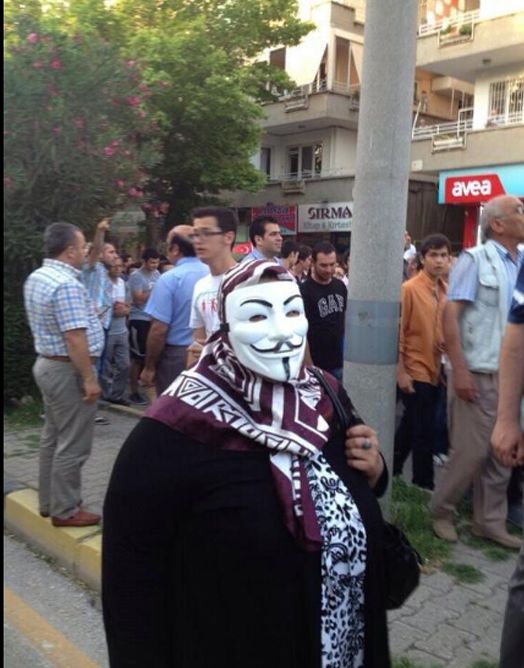
An elderly woman with her Guy Hawkes mask
A man and his best friend
Two young women in Islamist headscarves with a poster that reads "Don't give in"
Turning pepper gas canisters into flower pots
A young man and his guitar
And old man and his pen
These are the reactions of a civil society.
08 June 2013
Images from Occupy Istanbul
I am sure you must have seen many headlines comparing Occupy Istanbul (or Gezi Direnis as they call themselves) to the Arab Spring.
I am here to assert that they have nothing in common.
I will provide a theoretical framework tomorrow but first let me enumerate in lay terms all the points that make those events in Istanbul quite unique.
1) The starting point was about urban spaces and environmental concerns.
Roughly 100 well meaning environmental activists attempted a peaceful sit-in protests to protect a dozen trees.
Nothing earth shattering.

Then they were attacked by the police copying the NYPD's Occupy movement handbook. The police moved in around 5 a.m. burned their tents, used pepper spray on them and dispersed them with water cannons.
2) The reaction to police brutality was spontaneous.
As the activists hit the social media, thousands of people began pouring to the park. When they were attacked by the police, first tens of thousands then hundreds of thousands of people joined in.
People walked all night (Istanbul is vast city) to get there.
Perhaps for the first time in Turkey's history, participation had nothing to do with trade unions or political parties bussing in their supporters.
3) People from all walks of life joined the protest.
Just to provide an extreme example, in a macho and largely homophobic country like Turkey, there was a group of openly gay people with banners about their sexual identity and no one seemed to be bothered. (The banner on the right reads, "So what if we are queer")
Ultra-nationalists walked side-by-side with Kurdish separatists.
Soccer fans, who routinely beat each other up before or after soccer matches, entered the square as a united front.
Affluent housewives from posh neighborhood, who wouldn't be caught dead in such a crowd were chanting with women wearing the Islamic headscarf.

One woman with an Islamic turban had a banner that said "It is hard to take the AKP when you are sober."
Think about that. This is the woman in the picture on the left.
The one on her right reads "shoulder to shoulder against fascism."
These are people who most likely voted for the AKP in the past.

There is also this on the right. A Turkish Björk impersonator with a dove in her hand and her new found Islamist BFF.
4) The protesters received unexpected help from a large variety of people.
Shopkeepers in the area offered shelter, lemons (against pepper spray), water and anything else they needed.
Nearby five start hotels (like Divan) opened their doors to them, gave them food and shelter.

People offered their apartments as temporary shelter and put it on Twitter and post it on their buildings for passersby.
Interestingly, Starbucks refused and the following day there was a national boycott. They relented just in time.
5) The protesters organized themselves quickly and efficiently without the assistance of any Brotherhood or a political apparatus.
Within hours, they had the cell phones of pro bono lawyers on Twitter for people who were arrested (in terms of Smart Phone, Internet, Twitter and Facebook penetration Turkey leads Europe in most categories).
They set up Food Stands where people could phone in delivery of foods and put that on Twitter and Facebook.
They had a temporary field hospitals with physicians providing first aid to injured people.

They even had a field hospital for stray dogs who were affected by the pepper gas staffed by volunteer veterinarians. (image on the left)

Some protesters delivered first aid to stray dogs who live in the park.
And those dogs seem to have joined in the protests with banners of their own.
Here is a large clickable picture that shows all the facilities the protesters created after the first day.
Besides organizing themselves quickly, they did something very difficult to achieve: they took control of the message. After the disarray of the first day and violent confrontations with the police, they began stopping people from throwing stones or from swearing at the police.
Facebook and Twitter was full of short and informative "how to conduct ourselves" manuals.
They convinced the demonstrators that it is far better to be on the receiving end of excessive police force than to be shown on TV as angry people throwing stones.
And the woman in red became the iconic representation of that idea. Take a look at how she does not even move while being sprayed.

Perhaps their most unique gesture was to clean up the square after the first day of violent confrontations.
It seems to have touched a lot of indifferent people and convinced them that the demonstrators were responsible and serious individuals.
They still continue with daily clean-ups.
6) They rapidly got the message out.
After the first day, compiled videos began to appear on You Tube. Some with hauntingly beautiful background music.
Others (like "Everyday I am çapulling" using LMFAO's "Everyday I am shuffling") with a decidedly more mischievous take.
(Çapulling refers to Erdogan calling the protesters "Çapulcu" (pronounced chapooljoo but they simplified it as chapulcu in English posters and videos). It roughly means riffraff.
The protesters created a verb out of it as chapulling and there is a Wikipedia entry for it already.)
They managed to get an international solidarity movement with demonstrations in many countries and people claiming the label "capulcu."
They shamed Turkey's co-opted corporate media with very a effective image campaign on Twitter.
This one on the right shows CNN international live in Taksim and at the same moment CNN-Turkey broadcasting a documentary on penguins.
Another cable news channel NTV also ignored the events. The following day, some protesters went to their headquarters to denounce their dubious journalistic priorities. The company's CEO had to apologize.
The protesters than visited the HQ of Garanti Bankasi, another company owned by the same company that owns NTV and its CEO met with the protesters and declared himself a Capulcu.
Not to shabby for a bunch of Chapulcus!
7) Maintained a sense of humor
Their slogans and posters are very funny. And they are all over the place in Turkish social media.
But even the BBC took note. Their latest on Istanbul is entitled "Will Istanbul's Protesters Have the Last Laugh?"
--------------------
As of tonight at 7 p.m. Istanbul time, here is where they are. It looks like nobody is going anywhere. And no organization has asked for this.
I am here to assert that they have nothing in common.
I will provide a theoretical framework tomorrow but first let me enumerate in lay terms all the points that make those events in Istanbul quite unique.
1) The starting point was about urban spaces and environmental concerns.
Roughly 100 well meaning environmental activists attempted a peaceful sit-in protests to protect a dozen trees.Nothing earth shattering.

Then they were attacked by the police copying the NYPD's Occupy movement handbook. The police moved in around 5 a.m. burned their tents, used pepper spray on them and dispersed them with water cannons.
2) The reaction to police brutality was spontaneous.
As the activists hit the social media, thousands of people began pouring to the park. When they were attacked by the police, first tens of thousands then hundreds of thousands of people joined in.People walked all night (Istanbul is vast city) to get there.
Perhaps for the first time in Turkey's history, participation had nothing to do with trade unions or political parties bussing in their supporters.
3) People from all walks of life joined the protest.
Just to provide an extreme example, in a macho and largely homophobic country like Turkey, there was a group of openly gay people with banners about their sexual identity and no one seemed to be bothered. (The banner on the right reads, "So what if we are queer")Ultra-nationalists walked side-by-side with Kurdish separatists.
Soccer fans, who routinely beat each other up before or after soccer matches, entered the square as a united front.
Affluent housewives from posh neighborhood, who wouldn't be caught dead in such a crowd were chanting with women wearing the Islamic headscarf.

One woman with an Islamic turban had a banner that said "It is hard to take the AKP when you are sober."
Think about that. This is the woman in the picture on the left.
The one on her right reads "shoulder to shoulder against fascism."
These are people who most likely voted for the AKP in the past.

There is also this on the right. A Turkish Björk impersonator with a dove in her hand and her new found Islamist BFF.
4) The protesters received unexpected help from a large variety of people.
Shopkeepers in the area offered shelter, lemons (against pepper spray), water and anything else they needed.
Nearby five start hotels (like Divan) opened their doors to them, gave them food and shelter.

People offered their apartments as temporary shelter and put it on Twitter and post it on their buildings for passersby.
Interestingly, Starbucks refused and the following day there was a national boycott. They relented just in time.
5) The protesters organized themselves quickly and efficiently without the assistance of any Brotherhood or a political apparatus.
Within hours, they had the cell phones of pro bono lawyers on Twitter for people who were arrested (in terms of Smart Phone, Internet, Twitter and Facebook penetration Turkey leads Europe in most categories).
They set up Food Stands where people could phone in delivery of foods and put that on Twitter and Facebook.
They had a temporary field hospitals with physicians providing first aid to injured people.

They even had a field hospital for stray dogs who were affected by the pepper gas staffed by volunteer veterinarians. (image on the left)

Some protesters delivered first aid to stray dogs who live in the park.
And those dogs seem to have joined in the protests with banners of their own.
Here is a large clickable picture that shows all the facilities the protesters created after the first day.
Besides organizing themselves quickly, they did something very difficult to achieve: they took control of the message. After the disarray of the first day and violent confrontations with the police, they began stopping people from throwing stones or from swearing at the police.Facebook and Twitter was full of short and informative "how to conduct ourselves" manuals.
They convinced the demonstrators that it is far better to be on the receiving end of excessive police force than to be shown on TV as angry people throwing stones.
And the woman in red became the iconic representation of that idea. Take a look at how she does not even move while being sprayed.

Perhaps their most unique gesture was to clean up the square after the first day of violent confrontations.
It seems to have touched a lot of indifferent people and convinced them that the demonstrators were responsible and serious individuals.
They still continue with daily clean-ups.
6) They rapidly got the message out.
After the first day, compiled videos began to appear on You Tube. Some with hauntingly beautiful background music.
Others (like "Everyday I am çapulling" using LMFAO's "Everyday I am shuffling") with a decidedly more mischievous take.
(Çapulling refers to Erdogan calling the protesters "Çapulcu" (pronounced chapooljoo but they simplified it as chapulcu in English posters and videos). It roughly means riffraff.
The protesters created a verb out of it as chapulling and there is a Wikipedia entry for it already.)
![]() |
| Chomsky |
They managed to get an international solidarity movement with demonstrations in many countries and people claiming the label "capulcu."
They shamed Turkey's co-opted corporate media with very a effective image campaign on Twitter.This one on the right shows CNN international live in Taksim and at the same moment CNN-Turkey broadcasting a documentary on penguins.
Another cable news channel NTV also ignored the events. The following day, some protesters went to their headquarters to denounce their dubious journalistic priorities. The company's CEO had to apologize.
The protesters than visited the HQ of Garanti Bankasi, another company owned by the same company that owns NTV and its CEO met with the protesters and declared himself a Capulcu.
Not to shabby for a bunch of Chapulcus!
7) Maintained a sense of humor
Their slogans and posters are very funny. And they are all over the place in Turkish social media.
But even the BBC took note. Their latest on Istanbul is entitled "Will Istanbul's Protesters Have the Last Laugh?"
--------------------
As of tonight at 7 p.m. Istanbul time, here is where they are. It looks like nobody is going anywhere. And no organization has asked for this.
01 June 2013
Is Taksim Square Turkey's Tahrir Square?
That was the question posed by many commentators in the last two days.
Although I get the irony of a government hailed as the model that could enlighten the Arab Spring (I dissented) finding itself at the receiving end of popular anger, I doubt that there is any comparison.
I also do not think that these events would lead to dramatic changes in Turkey in the short run.
But I agree that the uprising points to a number of significant problems for the ruling party. And it is likely to be the harbinger of difficult times for the AKP.
There are several approaches to explain the underlying causes of public anger. The most benign is to point to what we could call the AKP fatigue. They have been around for ten years and this is a very long time for any government to be in power. Remember the Blair years in Britain or the Jean Chretien years in Canada. People are naturally sick of seeing the same faces making the same claims. They also blame them (rightly) for everything that goes wrong.
Alternatively, you could make a list of all the grievances expressed by the protesters and/or all the errors committed by the AKP. The list is long indeed: growing authoritarianism of Tayyip Erdogan, Turkey being the biggest jailer of journalists in the world, the creeping Islamization of the country, discontent with Syria policy and its terror implications, etc.
Without denying these factors, I believe that there are two fundamental reasons behind the protests: One is structural and the other accidental but taken together they suggest that there is no easy solution to this issue.
Paradoxes of the Politics of Polarization
From the outset, Tayyip Erdogan, the Prime Minister relied on a deliberate policy of polarization. His was an "us and them" approach reminiscent of the post-9/11 Bush administration's crusade mentality. As a general rule, the big advantage of polarization is that it forces all the groups who share your worldview generally to leave aside small disagreements to support your government through thick and thin. These groups move to the "us" block and stop voicing minor criticisms.
Obviously, polarization has the same unifying effect on the opposition but if you can find a way to divide them up or make the "them" bloc less worthy (like the GOP successfully turning the term "liberal" into a pejorative label), you will be very successful electorally.
Especially if you can combine this approach with sustained economic growth.
And to their credit, they did.
The problem for the AKP is that significant economic growth has a way of undermining the implementation of this polarization policy. If you make the "us" group the main beneficiary of that growth (and to keep them in your bloc you would have to), initially more people would want to join your side. And this is what happened in Turkey. While quadrupling the GNP and vociferously belittling their opponents they kept increasing their popular support. Ultimately, they won the last general elections with 50 percent of the vote.
However, over time, these policies backfire almost inevitably. And there is a simple logic to that: With an increasingly larger pie, the groups in your bloc would start competing with one another to get a better slice of it. The unity and cohesion of your bloc would become fairly questionable. And unless your government could keep the pie growing exponentially (which is impossible), sooner or later some groups within the bloc would stop supporting the ruling fraction. Or worse, they turn against it.
Similarly, the groups in the "them" bloc would realize over time that they would need to put their differences aside if they ever wanted to have a share of the national pie. The government's efforts to keep them divided would gradually become ineffective in the absence of suitable carrots to offer to them. Since the basic definition of politics is "who gets what, when and how" economic exclusion is a very powerful motivator for the opposition. (Remember Machiavelli's cynical advice? He told the Prince that he could kill people but he should never touch their property "because men more quickly forget the death of their father than the loss of their patrimony.")
And there is no easy solution: Bringing in some of the excluded groups would be fiercely resisted by the competing members of the ruling bloc who do not want to share the pie.
That leaves a no-carrot-and-stick-only approach. Hence the growing authoritarianism of Erdogan, the relentless pressure on large media companies to manipulate the news (for instance all the large TV channels have refused to report of the events in Taksim), the imprisonment of dissenting journalists, the dubious prosecution of officers and intellectuals through the Ergenekon trial.
Consequently, the AKP government is in a bind. In a reversal of the effects of their polarization policy, their internal coalition is crumbling and the opposition is growing more unified. A good if symbolic example from last night was the unity of soccer fans. Turkish soccer fans are rabidly fanatical and they hate each other with a passion. But last night, the supporters of the three major teams entered the Taksim Square together chanting slogans about their united determination to face the government. It is just a symbolic gesture but it is highly significant as this has never happened in living memory over any other issues.
Perhaps more tellingly, radical left wing, right wing and even pro-Kurdish groups (like the MPs from the BDP joined the protests. Given the animosity between the largely nationalistic opposition and the pro-Kurdish parties, this latter was an unexpected development.
Incidentally, do you know what Taksim means? Taksim Square refers to the central point in Istanbul from which municipal water used to be redistributed to the city. But the word "taksim" means to divide up and to distribute.
You will note the irony.
The second (and accidental) reason is Erdogan's delusions of grandeur coupled with a sense of time running out on him.
Hubris and Cancer
Erdogan has always been a belligerent politician. He has an in-your-face demeanor and he does not mince his words. In the early years this made him the perfect leader to implement the policy of polarization. Every time he insulted the colorless and ineffective head of the opposition his supporters felt proud and elated.
Like every charismatic politician, he was more brawn than brain.

When suddenly, in 2009, he was called upon to help implement the biggest transformation of the Middle East, he changed radically.
He began to project an image of a statesman. His speeches grew more ponderous and pedantic.
Like American Presidents bestowing upon themselves the gratuitous title of the "Leader of the Free World" he seemed to view himself as the Leader of the Middle East. His new Minister of Foreign Affairs formulated a policy of Neo-Ottomanism (making him the Sultan).
His bellicose style helped him gain admirers in the region, especially when he attacked Israel. But you could sense that he was a different man. In the process, he start distancing himself from his long time partner Abdullah Gul (who is currently the President. They used to have a Medvedev-Putin relationship with Gul acting as a stand-in for him on several occasion. But Gul was also the brain of the operation.
Yet, after 2009, Erdogan stopped taking Gul's advice and Gul began expressing mild but very public criticisms of Erdogan's actions and decisions (He spoke out against police brutality about these recent events).
In late 2011, Erdogan was diagnosed with colon cancer (actually this was not reported in Turkey, they only acknowledged that he had to undergo an operation but I know from multiple reliable sources that his cancer was serious and at the time of the operation it had metastasized to his lymph nodes). The chemo was successful to stop the progression of the disease but he is not cured.

So, he is acutely aware that he does not have much time.
Since his chemo treatment there has been a radical change of style. He now works incredibly long hours. He never takes time off. He looks unhealthy in his TV appearances. And he became extremely short tempered and angry. Apparently, he gets upset over any hesitation, any slow down and any resistance to his ideas.
In that sense, Erdogan and AKP are in a tough spot. The economic pie is not growing as rapidly as the competition over it and because of it, unlike the early days, they have to use more stick than carrot. On top of this, Erdogan thinks that he was given a mission form God (actually it is the US but that is the same thing in this context) and he has a small window to achieve it.
So, I expect more authoritarian and more abrupt reactions from him. Consequently, I would be very surprised if he backed down over Taksim.
But in the long run, these events will be remembered as a turning point for his government.
![]() |
| Woman in Red is the Iconic Image of These Events |
I also do not think that these events would lead to dramatic changes in Turkey in the short run.
But I agree that the uprising points to a number of significant problems for the ruling party. And it is likely to be the harbinger of difficult times for the AKP.
There are several approaches to explain the underlying causes of public anger. The most benign is to point to what we could call the AKP fatigue. They have been around for ten years and this is a very long time for any government to be in power. Remember the Blair years in Britain or the Jean Chretien years in Canada. People are naturally sick of seeing the same faces making the same claims. They also blame them (rightly) for everything that goes wrong.
Alternatively, you could make a list of all the grievances expressed by the protesters and/or all the errors committed by the AKP. The list is long indeed: growing authoritarianism of Tayyip Erdogan, Turkey being the biggest jailer of journalists in the world, the creeping Islamization of the country, discontent with Syria policy and its terror implications, etc.
Without denying these factors, I believe that there are two fundamental reasons behind the protests: One is structural and the other accidental but taken together they suggest that there is no easy solution to this issue.
Paradoxes of the Politics of Polarization
From the outset, Tayyip Erdogan, the Prime Minister relied on a deliberate policy of polarization. His was an "us and them" approach reminiscent of the post-9/11 Bush administration's crusade mentality. As a general rule, the big advantage of polarization is that it forces all the groups who share your worldview generally to leave aside small disagreements to support your government through thick and thin. These groups move to the "us" block and stop voicing minor criticisms.
Obviously, polarization has the same unifying effect on the opposition but if you can find a way to divide them up or make the "them" bloc less worthy (like the GOP successfully turning the term "liberal" into a pejorative label), you will be very successful electorally.
Especially if you can combine this approach with sustained economic growth.
And to their credit, they did.
The problem for the AKP is that significant economic growth has a way of undermining the implementation of this polarization policy. If you make the "us" group the main beneficiary of that growth (and to keep them in your bloc you would have to), initially more people would want to join your side. And this is what happened in Turkey. While quadrupling the GNP and vociferously belittling their opponents they kept increasing their popular support. Ultimately, they won the last general elections with 50 percent of the vote.
However, over time, these policies backfire almost inevitably. And there is a simple logic to that: With an increasingly larger pie, the groups in your bloc would start competing with one another to get a better slice of it. The unity and cohesion of your bloc would become fairly questionable. And unless your government could keep the pie growing exponentially (which is impossible), sooner or later some groups within the bloc would stop supporting the ruling fraction. Or worse, they turn against it.
Similarly, the groups in the "them" bloc would realize over time that they would need to put their differences aside if they ever wanted to have a share of the national pie. The government's efforts to keep them divided would gradually become ineffective in the absence of suitable carrots to offer to them. Since the basic definition of politics is "who gets what, when and how" economic exclusion is a very powerful motivator for the opposition. (Remember Machiavelli's cynical advice? He told the Prince that he could kill people but he should never touch their property "because men more quickly forget the death of their father than the loss of their patrimony.")
And there is no easy solution: Bringing in some of the excluded groups would be fiercely resisted by the competing members of the ruling bloc who do not want to share the pie.
That leaves a no-carrot-and-stick-only approach. Hence the growing authoritarianism of Erdogan, the relentless pressure on large media companies to manipulate the news (for instance all the large TV channels have refused to report of the events in Taksim), the imprisonment of dissenting journalists, the dubious prosecution of officers and intellectuals through the Ergenekon trial.
Consequently, the AKP government is in a bind. In a reversal of the effects of their polarization policy, their internal coalition is crumbling and the opposition is growing more unified. A good if symbolic example from last night was the unity of soccer fans. Turkish soccer fans are rabidly fanatical and they hate each other with a passion. But last night, the supporters of the three major teams entered the Taksim Square together chanting slogans about their united determination to face the government. It is just a symbolic gesture but it is highly significant as this has never happened in living memory over any other issues.
Perhaps more tellingly, radical left wing, right wing and even pro-Kurdish groups (like the MPs from the BDP joined the protests. Given the animosity between the largely nationalistic opposition and the pro-Kurdish parties, this latter was an unexpected development.
Incidentally, do you know what Taksim means? Taksim Square refers to the central point in Istanbul from which municipal water used to be redistributed to the city. But the word "taksim" means to divide up and to distribute.
You will note the irony.
The second (and accidental) reason is Erdogan's delusions of grandeur coupled with a sense of time running out on him.
Hubris and Cancer
Erdogan has always been a belligerent politician. He has an in-your-face demeanor and he does not mince his words. In the early years this made him the perfect leader to implement the policy of polarization. Every time he insulted the colorless and ineffective head of the opposition his supporters felt proud and elated.
Like every charismatic politician, he was more brawn than brain.

When suddenly, in 2009, he was called upon to help implement the biggest transformation of the Middle East, he changed radically.
He began to project an image of a statesman. His speeches grew more ponderous and pedantic.
Like American Presidents bestowing upon themselves the gratuitous title of the "Leader of the Free World" he seemed to view himself as the Leader of the Middle East. His new Minister of Foreign Affairs formulated a policy of Neo-Ottomanism (making him the Sultan).His bellicose style helped him gain admirers in the region, especially when he attacked Israel. But you could sense that he was a different man. In the process, he start distancing himself from his long time partner Abdullah Gul (who is currently the President. They used to have a Medvedev-Putin relationship with Gul acting as a stand-in for him on several occasion. But Gul was also the brain of the operation.
Yet, after 2009, Erdogan stopped taking Gul's advice and Gul began expressing mild but very public criticisms of Erdogan's actions and decisions (He spoke out against police brutality about these recent events).
In late 2011, Erdogan was diagnosed with colon cancer (actually this was not reported in Turkey, they only acknowledged that he had to undergo an operation but I know from multiple reliable sources that his cancer was serious and at the time of the operation it had metastasized to his lymph nodes). The chemo was successful to stop the progression of the disease but he is not cured.

So, he is acutely aware that he does not have much time.
Since his chemo treatment there has been a radical change of style. He now works incredibly long hours. He never takes time off. He looks unhealthy in his TV appearances. And he became extremely short tempered and angry. Apparently, he gets upset over any hesitation, any slow down and any resistance to his ideas.
In that sense, Erdogan and AKP are in a tough spot. The economic pie is not growing as rapidly as the competition over it and because of it, unlike the early days, they have to use more stick than carrot. On top of this, Erdogan thinks that he was given a mission form God (actually it is the US but that is the same thing in this context) and he has a small window to achieve it.
So, I expect more authoritarian and more abrupt reactions from him. Consequently, I would be very surprised if he backed down over Taksim.
But in the long run, these events will be remembered as a turning point for his government.
14 May 2013
The Name is Bondholder, Senior Bondholder
My friends have been telling me that my Eurozone commentary suggests that I might be a tad too critical of capitalist institutions and not critical enough of those periphery countries. You know, those notoriously lazy and irresponsible PIIGS.
As a contrarian, I am rather sensitive to polite accusations. Disagree with me violently, I am almost giddy. Insinuate slight bias, I am concerned. I stand for incontrovertible prejudice.
So, I thought the best way to figure this out would be to see the terms of successive bailouts in these countries and see who lost and who won. That would be a simple and straightforward way of prosecuting my case, right?
Let's start with Ireland.
Ireland
A while ago, I related in some detail how the Irish government was duped by senior bondholders to guarantee the private debt of Irish banks. But that was only part of the story. Since I wrote those lines I discovered that, at the time, European authorities were adamant that unsecured senior bond holders were to be paid in full. To put it differently, they wanted poor Irish peasants to bailout TBTF banks like Société Générale and Goldman Sachs.
We all know what happened.
What about Greece?
Greece
For Greece, I maintained from early on that they should default on their debt and leave the Eurozone.
European leaders had a different view. They told them they should stay put and implement austerity measures. Which meant a vicious cycle that would ensure that Greece would remain indebted for the foreseeable future. The ensuing Greek bailout was presented as a serious haircut for senior bondholders. In case you don't remember, this was a contemporaneous observation:
If you were getting your information from corporate media sources, you had probably retained that impression. Well, that's not what the celebrated economist Nouriel Roubini retained:
And they owe a lot more to senior bondholders.
Let's take a look at Spain.
Spain
As I wrote recently, Spain was doing reasonably well with a modern and diversified economy. Their main problem was (like everywhere else) in the banking sector. Their banks made risky real estate bets and lost a bundle when the bubble burst. Just like banks in Iceland, Ireland, Greece, Italy (and of course the US).
The only difference, in Spain, the source of funding was somewhat different. Banks sold subordinated bonds (the ones designed to take the first hit in a liquidation) mostly to retail investors. Meaning, mostly regular folks and their retirement funds. Interestingly, in the case of Spain, European authorities rediscovered the concept of risk for these bonds and insisted that these bondholders should be subjected to a deep haircut.
You might say, okay, it is never too late to go back to a principled stance. Capitalism equals risks and rewards. Right? So, good for them.
Well, not quite. That principled stance did not cover the senior bondholders.
You see, under normal circumstances, senior bondholders should be bailed in, i.e. the debt they are holding should be converted into equity in the bailed out institutions. In fact, this is an integral part of the new banking regulation framework of the EU. Except, it was not applicable for the Spanish case. For one thing, European authorities postponed its implementation until 2018. For another, the finance ministers overruled the ECB and refused to let senior bondholders to be bailed in or to get a serious haircut.
If the bondholders are the usual suspects, the senior bondholders, sorry, we have to make them whole, because, well, you know, they are senior bondholders.
I am guessing that by now you are noticing a pattern.
Let's take a look at the unusual Cyprus bailout.
Cyprus
The Cypriot case was similar to the previous ones, except for two key differences. Their banks, besides the usual reckless credit extension to dubious real estate projects, made a second bet on Greek debt, after Greece became a clear candidate for bankruptcy. When the final deal was decided upon the island banks were not among the senior bondholders that got the sweet deal. They were in the same category as Spanish retail investors.
The second difference was that since the early 2000's, Russian companies have been using Cypriot banks as a way of not paying taxes at home.
When the EU officials began to look for a bailout formula, they had this very controversial and dangerous idea. They thought that they should make the depositors pay for the funds to be raised. Originally, they wanted both the insured (up to €100,000) and uninsured (over that amount) depositors to take part in the scheme.
It is hard to emphasize how radical an idea it is to levy a fee on insured deposits. As far as I know, it is a first anywhere. Given the shaky foundations of the Euro it soon became apparent that touching insured deposits might lead to a run on the banks.
They eventually dropped the idea but since the uninsured depositors were mostly Russian, they focused on them instead. And they are the ones footing the bill.
If you read this far, you must be asking "what about the senior bondholders?"
Well, you'll be happy to know that even as they burned depositors, the EU authorities saved senior bondholders:
I hope that through all this I established that I am NOT slightly biased about capitalist institutions.
It is a full-blown prejudice.
As a contrarian, I am rather sensitive to polite accusations. Disagree with me violently, I am almost giddy. Insinuate slight bias, I am concerned. I stand for incontrovertible prejudice.
So, I thought the best way to figure this out would be to see the terms of successive bailouts in these countries and see who lost and who won. That would be a simple and straightforward way of prosecuting my case, right?
Let's start with Ireland.
Ireland
A while ago, I related in some detail how the Irish government was duped by senior bondholders to guarantee the private debt of Irish banks. But that was only part of the story. Since I wrote those lines I discovered that, at the time, European authorities were adamant that unsecured senior bond holders were to be paid in full. To put it differently, they wanted poor Irish peasants to bailout TBTF banks like Société Générale and Goldman Sachs.
We all know what happened.
What about Greece?
Greece
For Greece, I maintained from early on that they should default on their debt and leave the Eurozone.
European leaders had a different view. They told them they should stay put and implement austerity measures. Which meant a vicious cycle that would ensure that Greece would remain indebted for the foreseeable future. The ensuing Greek bailout was presented as a serious haircut for senior bondholders. In case you don't remember, this was a contemporaneous observation:
A myth is developing that private creditors have accepted significant losses in the restructuring of Greece’s debt; while the official sector gets off scot free. International Monetary Fund claims have traditional seniority, but bonds held by the European Central Bank and other eurozone central banks are also escaping a haircut, as are loans from the eurozone’s rescue funds with the same legal status as private claims. So, the argument runs, private claims have been “subordinated” to official ones in a breach of accepted legal practice.Do you think that this was indeed the case?
If you were getting your information from corporate media sources, you had probably retained that impression. Well, that's not what the celebrated economist Nouriel Roubini retained:
The reality is that private creditors got a very sweet deal while most actual and future losses have been transferred to the official creditors.
Even after private sector involvement, Greece’s public debt will be unsustainable at close to 140 per cent of gross domestic product: at best, it will fall to 120 per cent by 2020 and could rise as high as 160 per cent of GDP. Why? A “haircut” of €110bn on privately held bonds is matched by an increase of €130bn in the debt Greece owes to official creditors. A significant part of this increase in Greece’s official debt goes to bail out private creditors: €30bn for upfront cash sweeteners on the new bonds that effectively guarantee much of their face value. Any future further haircuts to make Greek debt sustainable will therefore fall disproportionately on the growing claims of the official sector. [emphasis mine]More importantly,
The new bonds will also be subject to English law, where the old bonds fell under Greek jurisdiction. So if Greece were to leave the eurozone, it could no longer pass legislation to convert euro-denominated debt into new drachma debt. This is an amazing sweetener for creditors.Remember my recommendation about defaulting and leaving the Eurozone? Now they are stuck with a much larger debt and absolutely no way of fixing their problems. They cannot devalue their currency, stimulate the economy or even print money to reduce their debt through inflation.
And they owe a lot more to senior bondholders.
Let's take a look at Spain.
Spain
As I wrote recently, Spain was doing reasonably well with a modern and diversified economy. Their main problem was (like everywhere else) in the banking sector. Their banks made risky real estate bets and lost a bundle when the bubble burst. Just like banks in Iceland, Ireland, Greece, Italy (and of course the US).
The only difference, in Spain, the source of funding was somewhat different. Banks sold subordinated bonds (the ones designed to take the first hit in a liquidation) mostly to retail investors. Meaning, mostly regular folks and their retirement funds. Interestingly, in the case of Spain, European authorities rediscovered the concept of risk for these bonds and insisted that these bondholders should be subjected to a deep haircut.
You might say, okay, it is never too late to go back to a principled stance. Capitalism equals risks and rewards. Right? So, good for them.
Well, not quite. That principled stance did not cover the senior bondholders.
You see, under normal circumstances, senior bondholders should be bailed in, i.e. the debt they are holding should be converted into equity in the bailed out institutions. In fact, this is an integral part of the new banking regulation framework of the EU. Except, it was not applicable for the Spanish case. For one thing, European authorities postponed its implementation until 2018. For another, the finance ministers overruled the ECB and refused to let senior bondholders to be bailed in or to get a serious haircut.
In July, when the euro zone negotiated a bailout for Spain’s banks, the European Central Bank argued that they should be “bailed in” in cases where a bank is so sick it needs to be closed. At the time, the European Commission insisted senior bondholders would remain protected and the euro zone’s commitment to do so wasn’t tested, since none of the Spanish cajas were ultimately wound down.In other words, if the bondholders were you and me and our retirement funds, too bad, we knew the risks: Haircut.
If the bondholders are the usual suspects, the senior bondholders, sorry, we have to make them whole, because, well, you know, they are senior bondholders.
I am guessing that by now you are noticing a pattern.
Let's take a look at the unusual Cyprus bailout.
Cyprus
The Cypriot case was similar to the previous ones, except for two key differences. Their banks, besides the usual reckless credit extension to dubious real estate projects, made a second bet on Greek debt, after Greece became a clear candidate for bankruptcy. When the final deal was decided upon the island banks were not among the senior bondholders that got the sweet deal. They were in the same category as Spanish retail investors.
The second difference was that since the early 2000's, Russian companies have been using Cypriot banks as a way of not paying taxes at home.
When the EU officials began to look for a bailout formula, they had this very controversial and dangerous idea. They thought that they should make the depositors pay for the funds to be raised. Originally, they wanted both the insured (up to €100,000) and uninsured (over that amount) depositors to take part in the scheme.
It is hard to emphasize how radical an idea it is to levy a fee on insured deposits. As far as I know, it is a first anywhere. Given the shaky foundations of the Euro it soon became apparent that touching insured deposits might lead to a run on the banks.
They eventually dropped the idea but since the uninsured depositors were mostly Russian, they focused on them instead. And they are the ones footing the bill.
If you read this far, you must be asking "what about the senior bondholders?"
Well, you'll be happy to know that even as they burned depositors, the EU authorities saved senior bondholders:
In the bailout deal that the euro zone and the International Monetary Fund hammered out for Cyprus, one class of investors once again made a lucky escape: senior bank bondholders. (...)
The euro zone has to far carefully avoided burning senior bondholders during a bank restructuring. (...)
With relatively little money to gain, officials decided that breaking two taboos — taxing depositors and burning senior bondholders — in one go, didn’t seems like a good idea.The last sentence reads like a punchline, doesn't it?
I hope that through all this I established that I am NOT slightly biased about capitalist institutions.
It is a full-blown prejudice.
13 May 2013
Things Will Get Complicated in Bangladesh and in the Region
I have been following the developments in Bangladesh with a mixture of concern and bemusement. I am not talking about the tragic loss of life in a makeshift garment factory. This was terrible but pointing to the horrific aspects of capitalism and our never ending desire to exploit people in search of cheaper items of consumption is not a novel perspective.
I was concerned about the ramifications of the case against the deputy leader of the opposition party Jamaat-e-Islami. I knew that regardless of the outcome many people would die. My bemusement had nothing to do with Bangladesh or these events. I thought the ignorance of the corporate media was almost funny. They presented the situation as yet another example of the rise of Islamist forces. They breathlessly reported about Islamists going after bloggers and demanding new blasphemy laws. This is mostly rubbish because it ignores the whole context of the issue.
Many people outside Bangladesh don't realize that there are two critically important elements at the core of the Bangladeshi identity. One is their language, Bengali. It unifies them, gives them a regional identity (Bengal) and it also separates them from their Urdu and Hindi speaking neighbors. The second element is the war of liberation in 1971.
In fact, the two are inextricably linked because one of the main reasons "East Pakistan" rose against Pakistan was the massive ethnic and linguistic discrimination they were subjected to on a daily basis. As you might know, after a particularly bloody war with millions of people dead, injured or displaced, East Pakistan became Bangladesh.
Notice Islam is not one of the core elements of Bangladeshi identity even though a huge majority of Bangladeshis are Muslims. That is partly because Islamic entities and especially Jamaat-e-Islami were against independence and they actively sided with the Pakistani oppressors. They tortured and killed thousands of intellectuals. And Bangladeshis never forgot that.
The current government was elected partly on a platform of setting up special tribunals to prosecute what they call war criminals. Nine senior leaders of Jamaat-e-Islami were charged with crimes against humanity and in January Abul Kalam Azad was found guilty in absentia and was sentenced to death. Then Abdel Kader Mullah was found guilty and sentenced "only" to life in prison. This led some bloggers to declare his punishment as too light.
And that is why Jamaat-e-Islami has begun asking for new blasphemy laws against bloggers. And that is why they have been protesting violently. In other words, they were basically acting as a partisan force and not necessarily as easily offended Islamists.
Since then Delwar Hossain Sayeedi was sentenced to death and yesterday it was Muhammad Kamaruzzaman's turn. Each time one side took the streets to express jubilation and the other side to stop them. As you can imagine, many people died in the process.
I knew that if the Kamaruzzaman outcome was a lighter sentence, people were going to protest and there would be clashes with Jamaat-e-Islam. If the sentence was the death penalty, then I assumed that the Jamaat-e-Islami supporters were going to escalate their protests.
Either way, I fear many people will die needlessly. And things will get complicated.
You see, the war of independence had three parties. Pakistan, the loser, Bangladesh the winner and India the supporter. Pakistan is about to go to polls. They are currently in a bizarre tug of war with India: where each side kills a prisoner every week to revenge a previous killing.
The outcome of the Pakistani elections is hugely important.
Moreover, the domestic tensions in Bangladesh will almost certainly have repercussions in India-Pakistan relations.
I am worried.
-----------------
I wrote (and thought published) this on 9 May at an airport lounge. I realized now that the wi fi system kicked me out before my publish command reached Blogger. Consequently, the date references (like yesterday) are off. My apologies.
Subscribe to:
Posts (Atom)