20 March 2016

Where is Turkey Going?

The short answer is "to hell in a hand basket" especially after the most recent suicide bombing in Istanbul.

The long answer has the same destination but a more complicated path.

First, let me give you a snapshot of the current situation.

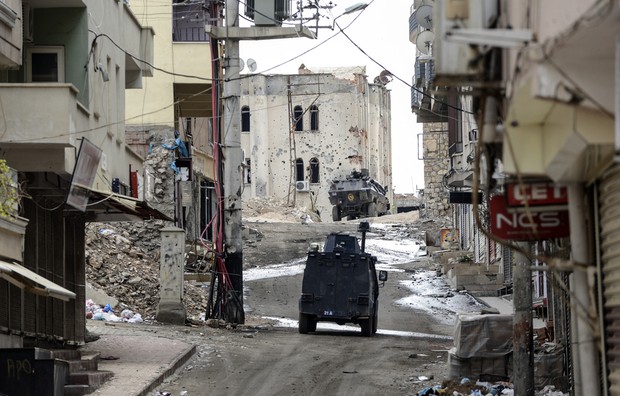
There is a civil war going on in its Southeast region where hundreds maybe thousands of Kurdish civilians were killed by government troops which have been acting like an invading army. Reportedly, they bomb civilian areas indiscriminately. They impose prolonged curfews and have snipers shoot those who venture out. They let the wounded die and the dead rot on the street.

Curfew
Every time the curfew is lifted, thousands leave their town in search of a safe haven. Their eventual return is made very difficult by carpet bombing which destroy their homes and their belongings. In their new location they are left with nothing but bitterness and a deep hatred towards what they perceive as a callous Turkish state and a largely indifferent Turkish civil society.

Curfew

The PKK, which helped Erdogan win a second snap election by inexplicably breaking its long held cease fire after a hung Parliament last June, continues its highly destructive campaign of terror. In the last two months, it (technically a splinter group called TAK) sent two suicide bombers to Ankara killing scores of people and wounding and traumatizing many more.

These tactics were so stupid and counter-productive from a Kurdish perspective that some commentators wondered whether PKK was a stooge of Turkish authorities.

Governance is also a serious problem. Ever since Erdogan became the first President elected by popular vote in 2014, the country has had two executive branches. After his victory, Erdogan announced that there was now a de facto presidential system. An executive presidency on top of a British style parliamentary system means that the President is now the leader of both the executive and legislative branches.

The current Prime Minister Ahmet Davutoglu tried to argue that he was the head of government and Erdogan was the head of state but Erdogan simply ignored him and continued to run the place as if a constitutional change had been enacted.

In fact, one could say that Erdogan has also become the head of the judiciary. Since December 2013, he removed all judges and prosecutors who were not in line with his various positions. We are not talking about a few appointments, it is a massive purge involving thousands of judges, prosecutors and police officers.
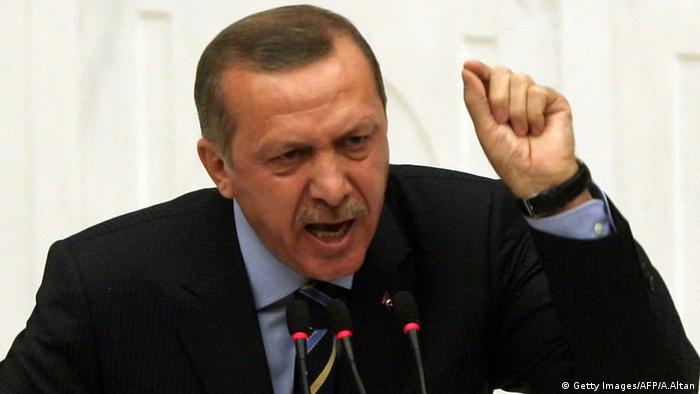
Almost weekly Erdogan directs prosecutors to charge specific journalists, academicians and dissenters. And almost always, they comply.

Moreover, recently, when the Supreme Court released two journalists who were charged with espionage (on the say so of Erdogan) for reporting on weapons the Turkish Intelligence Agency (MIT) sent to ISIS, the President said that he did not respect the decision and did not see the need to abide by it.

And for good measure, he threatened to abolish the Supreme Court.

I am sure both Victor "illiberal democracy" Orban and Jarosław Kaczyński are deeply envious.

Not surprisingly, there is no freedom of the press left. As soon as an important incident takes place and journalists begin reporting, the government issues a publication ban. If a scandal is uncovered, Twitter and Facebook are immediately blocked to prevent its dissemination.

Most papers are either openly pro-government and print outright falsehoods or they are very careful not to print anything that might offend Erdogan. The remaining few opposition outlets are raided routinely, accused of supporting terrorism and placed under the tutelage of pro-government trustees.

The latest practice is to refuse accreditation to foreign journalists. Besides Der Spiegel journalist (who had to be escorted to the airport by a German diplomat as he feared an attack), a total of eight foreign correspondents, including those working for Die Welt, Frankfurter Allgemeine and Norwegian Aftenposten have recently been forced to leave the country.

Turkish foreign policy is in shambles. Its cynical Syria policy of protecting Pipelineistan by protecting ISIS was blocked by Putin. Turkey has serious problems with every country in the region other than Qatar and perhaps Saudi Arabia (as they disagree on Egypt and Muslim Brotherhood).

Besides all its neighbors, the Turkish government has managed to simultaneously antagonize the US, European Union and Russia. Which is a remarkable feat in and of itself.

Finally, the economy is in a free fall. The Russian sanctions affected many sectors. The hardest hit was the tourism and hospitality industries. Anecdotal evidence suggests that most hotels in Antalya (a destination favored by Russians) are for sale. Bookings are significantly down in other cities following suicide bombings. Exports plunged to their lowest level in five years.

The question is why all of this happened.

Ostensibly, it was to accommodate the ambitions of one person, Recep Tayyip Erdogan, a modern day Nero figure fiddling with his mobile phone while Rome is burning.

Eastern Rome, that is.

But, as you can imagine, there is more to it than that.

Erdogan's Strategery

It is a truism that Erdogan wants to be President. And perhaps also Sultan and Caliph. But it is more than a personal ambition. He desperately needs to insulate himself and the immense wealth he accumulated from domestic and international prosecution.

Domestically, he is exceptionally well placed to achieve his goals.

His constituency is composed of a core group of pious Muslims, a fluid coalition of Small and Medium Enterprise (SME) owners and mid-level and senior corporate managers who are afraid of economic turmoil post-AKP period might entail, single issue ultra-nationalists who are convinced that Turkey would disintegrate if Kurdish threat was not addressed, urban poor whose status improved significantly under AKP rule and generally conservative people who are suspicious of change and of people who ask for it.

When prodded with fear-inducing rhetoric, like internal and external enemies lurking in the shadows, these groups coalesce and provide him with comfortable majorities.

The core Muslim group will back him up no matter what. It is not just because they adore him: they are too afraid of the backlash that will almost certainly be the hallmark of a post Erdogan period. They are petrified that they will lose everything they gained and then some.

The small business owners and corporate managers are convinced that none of the opposition parties can manage the economy. So, they see AKP as the only option for their economic prosperity.

The nationalists view Erdogan as the only leader who can put the Kurds in their place and destroy their demands for more rights and some form of autonomy.

On top of all that there is the fact that, the main opposition party, the CHP has a substantial nationalist fraction. While its members would not vote for Erdogan ordinarily, they might consider it if the so called "Kurdish threat" reached a certain level.

Like suicide bombings all over the place.

So Erdogan's demonizing "terrorists" discourse against Kurds and his harsh military tactics targeting civilians make a lot of political sense.

Besides garnering the support of these disparate groups, it also places the pro-Kurdish party HDP into a defensive posture. HDP cannot openly criticize PKK as this latter is viewed as the defender of Kurds by the majority of Kurdish people, which is also HDP's basic constituency. Consequently, to denounce them as terrorist sympathizers is a child's play for Erdogan.

In that vein, he has already directed the Parliament to lift the legislative immunity of some HDP MPs. When that happens, prosecutors appointed by Erdogan will charge them with aiding and abetting terrorism and put them in jail.

You can guess the rest of the scenario: with the current military campaign pushing Kurds out of the Southeast, the composition of the electorate is rapidly changing. To ensure an even better result, Erdogan is urging Syrian refugees to settle in predominantly Kurdish towns. And he began offering citizenship to some Syrians. Observers expect them to become a major political force in the next electoral cycle.

If HDP is removed from Parliament, Erdogan will be able to call early elections. It is almost certain that HDP would be unable to pass the 10 percent threshold this time and with "terrorists" battle cry unifying Sunni Turks against a common enemy, Erdogan might finally get the super majority he craves.

And that would give him the Presidency. And the Sultanate and the Caliphate.

That is his road map.

Can anyone stop him?

That is a question for my next post.

08 March 2016

Ray Tomlinson Was One of My Heroes

If you are not a geek, you probably said "Ray who"?

Ray Tomlinson, who passed away yesterday, was the inventor of the ubiquitous email.

He wrote its protocol (SMTP), developed the first email program (SNDMSG) and perhaps most importantly, grabbed the seldom used @ key to denote the address.

Although email is the most popular application of all time by a huge margin, Tomlinson never made a dime.

And that is why he was one of my heroes. Not because he didn't make money off of his invention but because he proved that the patent trolls' argument is rubbish.

You see, conservatives always maintain that Intellectual Property (IP) needs to be protected and very richly remunerated because otherwise nobody would bother with inventing things.

I always counter this with the argument that, well protected IP, far from being a motivator, is usually a hindrance to further progress.

Do you remember CompuServe or AOL? They were known as walled gardens. If Internet was not a public utility, we would still be in those gardens. And we would have a fraction of the current Internet content.

And we would be paying dearly for the privilege.

Bil Gates became a multibillionnaire by licensing to IBM a program developed by a guy named Tim Paterson and in the process his company Microsoft blocked most PC-related inventions for over a decade.

Ray Tomlinson invented a new method of communication and gave it to the world with a smile.

We need more Tomlinsons.

27 February 2016

Why No One Wants to Stop ISIS?

This is not a rhetorical question. I am genuinely curious.

My fascination with ISIS began when I discovered their branding and marketing prowess.

This was a supposedly Salafist organization aiming to strictly emulate early Muslims and yet it had movie studios churning out feature-length high production value films and video clips.

It had software development units that enabled their black-clad goons to tweet hundreds of thousands times a day.

It had an extraordinary marketing department that successfully branded their organization (ISIS) and re-branded it again (IS), making it very attractive in the process to all kinds of people from around the globe.

I posted about that aspect extensively. I also tried to explain their attraction and the adherents' deep problem with identity.

These turn out to be some of the most popular posts of this humble soapbox.

My fascination turned into a healthy obsession when I realized that that these black-clad thugs were actually there for a mission and they were extremely well-funded. The moment they showed up they had roughly $4 billion, courtesy of Qatari royal family.

When I did some digging, I discovered that their entire organization was created from scratch by Saddam's intelligence officers like Samir Abd Muhammad al-Khlifawi, who recruited al-Baghdadi to give religious cover to that mission.

I also found out that the highly successful ISIS brigades executing complex tactics  and invading large swaths of territory in Iraq and Syria were not a bunch of disaffected Arab kids from European suburbs like Molenbeek or Saint Denis, as corporate media outlets kept telling us, but they were the Naqshibandi Army (JRTN), a highly sophisticated military force established by Izzat Ibrahim al Douri, Saddam's Vice President and Deputy Chairman of Iraq's Revolutionary Command Council.

You know, the infamous "King of Clubs."

And it is not just the military as most of the municipal structures in the ISIS Empire are run by former Baath officials.

After al-Khlifawi was accidentally killed by some rival Salafist thugs, Der Spiegel purchased his notes and the plans he used to set up ISIS. They reported in detail how a small group of ISIS militants would move to a town, keep a low profile, collect information about leading figures, blackmail them or take them out systematically and try to win over the residents through propaganda.

They would also try to win hearts and minds by providing municipal services and reduce or eliminate taxation.

Interestingly, my pieces about the involvement of intelligence agencies and non-Islamic elements in ISIS were some of the least popular posts in the history of this blog. I encounter a similar disinterest when I discussed my findings with friends and acquaintances.

It was as if people did not want to understand why ISIS was doing what it was doing. Making their actions intelligible through a rational causal framework bothered people. They seemed to prefer the emotional simplicity of the barbaric and demonic "other." Maybe they thought "understanding" ISIS would make them less evil.

I don't know.

All of this to tell you that recently, I came across two news items about both the marketing efforts of ISIS and its methodical organization in a new territory. They corroborated my initial take on these issues and they made me wonder if we really want to stop ISIS.

An alleged defector from ISIS appeared in a video (produced by a rival Jihadist group) claiming that many of the clips produced by ISIS were actually fake.
The video begins with the defector describing how he was asked to attack mosques by IS commanders. But the section of the video that really captured the imagination of Twitter users outlines alleged IS trickery in filming fake battle scenes which the group falsely claimed as genuine military victories.

The defector describes how he was enlisted to fake fights and raids in front of the camera. In some scenes, he says, IS fighters pretended to be dead Houthi rebels and were daubed with fake blood in the form of the soft drink Vimto.
Incidentally, Vimto is a spicy fruit flavored drink highly popular in the Middle East and its undiluted color is fairly close to human blood.

The reformed Jihadi's allegation did not make me think that the previous atrocities ISIS filmed were mostly bogus. I am sure ISIS is a ruthless and barbaric terrorist outfit. What the allegations did was to reinforce my belief that ISIS is, above all, a cynical and effective marketing machine. They kill when they can, they fake when they can't, but either way they market, brand and market some more.

This is why you cannot fight them on religious grounds as some people advocated.

The second news item was about ISIS' adventures in Afghanistan. It was written by a local BBC journalist. Da'esh is the Arabic acronym for ISIS.
I first heard talk of Da'esh early in 2014. To be honest, at first I didn't think it was anything special, just another international jihadi movement. There have been a few of those around here, including al-Qaeda.

But soon it became clear that Da'esh was different.

Da'esh was built up by a small group of fighters, maybe 60 or 70 in total. Most of them came from over the border in Pakistan and it was obvious that they were being funded from abroad.

Right from the start Da'esh had lots of money and weapons. It was also very well organised, better organised than the Taliban ever was.
As they had the means, they followed their original script and avoided taxation.
They did not try to "tax" local people, something the Taliban and other jihadis do. That made them popular.
The local ISIS guy was duly interested in publicity,
In July 2014 I met one of the organisers of Da'esh in Afghanistan. He called me up out of the blue and asked if I would like to interview him. He knew I was a journalist and it was clear he wanted publicity.

The man told me he was printing Da'esh magazines and propaganda in Pashto, the local language. 
But he also wanted to keep a low profile.
He said the plan was they would keep a low profile, quietly building strength and support locally. An FM radio station was set up to broadcast propaganda in the region. 
Ultimately, the plan did not work out because the HQ could not control the rank and file zealots who killed the wrong people and alienated too many local players.

But the fact remains that their foray into Afghanistan shows that ISIS still follows al-Khlifawi's original blueprint.

Arrive in small numbers flush with money, check.

Organize rapidly while keeping a low profile, check.

Engage in Islamist propaganda to win people over, check.

Use your money to eliminate taxation and win people over, check.

My question is this: why is everyone continue to maintain that ISIS could be defeated with what Atrios calls freedom bombs when it is clear that, unless you confront their marketing and organizational blueprint, for every ISIS goon killed, there are going to be fifty more ready to take his place.

Why the US has not been putting any real pressure on Qatar and Saudi Arabia to cut off ISIS' funding? They do make some money off oil sales but that revenue stream is negligible compared to their expenditures and with recent Russian targeted strikes it has become even less lucrative.

Similarly, why hasn't Europe forced Turkey to stop providing arms and logistic support to ISIS and al Nusra Front, not to mention a very porous border? EU is Turkey's biggest trading partner, surely they have the means to exert some pressure.

I would have thought that preventing Islamist groups to perpetuate the Syrian civil war would be a more effective solution to the refugee crisis than trying to accommodate the mercurial Turkish President?

Also, why the US did not make its alleged displeasure with Turkey's Syria policy and support for ISIS the cornerstone of its relations with Ankara?

Syrian civil war is a war of proxy but the way Sunni-Shia divide is deteriorating and the Kurdish, Russian, Turkish chess game is evolving, there is a great likelihood for it to turn into an actual war.

A war that could engulf NATO.

So why is no one lifting a finger to reduce that risk?

Do we actually want to have a war there?

09 February 2016

Putin Is Pulling Erdogan into a Trap

In a recent post, I suggested that Russian strongman Vladimir Putin might be pulling his Turkish counterpart Tayyip Erdogan into a well-designed trap.

It now looks like my suggestion was prescient. Putin seems to have put together a comprehensive plan to draw Erdogan into a fight he cannot win. Or worse, to turn him into an impotent spectator.

Let me start with the Turkmens.

Everyone knows that a war of proxy is being fought in Syria. Turkey's avatar, if you will, has been the Turkmen minority. They are ethnic cousins, they dislike Kurds and they sympathize with ISIS and al Nusra front.

Check, check and check.

Since November, Russian jets have been attacking them relentlessly.
Following the downing of its jet, Russia intensified its air campaign, particularly against the Turkmens, but also against radical Islamic groups supported by Turkey, Saudi Arabia and Qatar that are fighting the Syrian army.

Russia has a particular ax to grind with the Turkmens because it was their fighters who killed the Russian pilot in his parachute after he ejected from the Su-24. 
As a result,  the group seen as Turkey's most reliable ally in Syria began to leave its region and seek shelter in Turkey.

Then there is ISIS and al Nusra Front.

Russia has been pounding ISIS and other Islamist groups around the clock in the last three months. In mid-December, CNN reported that in one 24 hour cycle there were "fifty-nine combat missions. Two hundred and twelve targets struck. Three hundred and twenty ISIS militants killed. And more than 100 oil facilities destroyed."

Largely as a result of this campaign, the number of ISIS fighters has dwindled considerably, according to the White House.
The latest assessment about the number of fighters who are fighting on behalf of ISIL in Iraq and in Syria was -- based on an earlier assessment -- was up to 31,500 fighters in that region of the world.  There’s a new assessment from our intelligence community that indicates that that number is now up to about 25,000 fighters. 
As I wrote many times before, Turkey has been spearheading the Sunni coalition promoting radical Sunni groups in Syria to establish what I termed Pipelineistan, a conservative Sunni state that would allow Qatari natural gas to reach Europe through Turkey to the great consternation of Russia, the sole current supplier.

Putin's third move was to provide support to Syrian Kurds. As you might know, PYD, the political organization of Syrian Kurds, is an offshoot of Turkey's PKK. They also happened to have the only ground force in Syria capable of fighting ISIS, which is called YPG or People's Protection Units.
Meanwhile, the Turkish media is reporting that Russia had started to provide air support to the PYD’s military wing, the People's Protection Units (YPG), west of the Euphrates River. This is bound to further fuel tensions between Ankara and Moscow.

Worried that the Syrian Kurds will gain an autonomous region along its border with Syria, Ankara has declared a PYD/YPG presence west of the Euphrates to be a red line. But what can Turkey do to stop this and the Syrian advances in northern Syria with Russian help? 
In fact, both the US and Russia have been courting PYD and its armed wing for some time now. But Putin tried to show off a bit more.
Escalating tension between Russia and Turkey will reach a new high when the Democratic Union party (PYD), the leading Kurdish political organisation in north-eastern Syria, which Ankara regards as a terrorist group, opens a representative office in Moscow on Wednesday at Vladimir Putin’s personal invitation.
Having removed Turkey's proxy from the Syrian theater, dealt a significant blow to its Islamist allies and bolstered its bête-noir what did Putin do?

Well, he deployed the most sophisticated Russian fighter jets and asked them to patrol the Turkish border all day long.

You know, in case Erdogan feels like challenging him.

The planes in question are Su-34 and Su-35.

By the way, this is the Su-34's first combat mission outside Russia and it is a very capable fighter jet.
Unlike the Fencer, the Su-34—taking full advantage of its Flanker lineage—is provisioned with a formidable air-to-air self-defense capability. In addition to short-range R-73 high off-boresight dogfighting missiles, the Su-34 carries the long-range radar-guided R-77 air-to-air missile. That means like its nearest Western equivalent, the Boeing F-15E Strike Eagle, the Fullback able to conduct “self-escorted” strike missions.
Notice the dogfighting arsenal and air-to-air combat missiles.

Then there is the ultra-maneuverable and sophisticated Su-35 Flanker, which was just shown to the world a few months ago.

According to a Turkish military analyst, Ret. Brig. Gen. Naim Barburoglu, these jets "are far more advanced than Turkey’s F-16s.”
“Unlike the Su-24, which only has air-to-ground capabilities, these jets have air-to-ground as well as air-to-air capabilities and are supported by the most advanced radar technology,” he added.
Moreover,
“Since the downing of the Russian jet, Turkish F-16s are unable to fly in Syrian airspace. The US doesn’t want them there either in case they confront Russian jets,” Baburoglu said. He pointed out that the Russian Su-35 Flanker-E type jets deployed in the region, which are far more advanced than anything Turkey has, is of concern to Washington.
There is more.

When Putin realized that Ankara was reticent to challenge Russian Air Force, he ordered them to violate Turkish air space. They did it twice so far and drew only loud protests from Turkey.The Russian ambassador was summoned and a formal protest was lodged.

Tellingly, the Turkish claim was carefully worded to ask Russia to respect NATO airspace, clearly hinting that it intends to get NATO involved in case of an escalation. But the Russian Ministry of Defense shrugged it off, calling the Turkish claim "pure propaganda."

That is because they are aware that NATO decisions are taken unanimously and it is extremely unlikely that Greece or France would vote to go to war over Erdogan's hostile acts like downing a plane over a 17 second airspace violation.

Let me make a safe prediction.

This will not end well.

05 February 2016

What Is Donald Trump Doing?

The Donald is doing something very interesting.

He is exposing the main electoral strategy GOP has been using since the beginning of the 20th century.

You see, GOP is no longer the party of Lincoln, as they like to boast. It is the party of racist and angry white men. As such, they specialize in race-baiting.

Everything they do is centered around an "other."

And the culmination of that was Nixon's Southern Strategy.  Perlstein's Nixonland should be required reading.

This is how it works.

The party elite forms the pool of candidates. They also predetermine the likely winners of primaries. They raise huge sums of money from the usual suspects, that is, wealthy donors like hedge fund managers and Koch brothers who are interested in having the President's/Senator's/Representative's ear.

Also known as Pay for Play.

Candidates are given a list of iron clad principles to which they are to adhere if they wish to get elected (or re-elected) and have access to those funds. These include, starving the beast, reducing taxes for the wealthy, eliminating safety net for the poor and increasing national security state and military spending.

Since these are not very attractive positions for the general electorate, the candidates are given talking points for each principle to make them palatable.

For instance, starving the beast is translated as "taxes are job killers." Tax cuts for the wealthy are important incentives for the Ayn Rand producers. Eliminating the safety net for the poor is a necessity because of the deficit. And spending more money on fighting terrorism is needed because of America's various enemies, the latest of which being "them crazy Muslims."

The critical element that unifies all these principles is the race-baiting subtext.

Starving the beast is also cutting off funding to parasitic minorities, you know, the mythical Cadillac driving black welfare queens.

Tax cuts for the wealthy underlines the belief system that there are two categories of people in the world: on one side you have white Shrugging Atlases, you know, the producers, and on the other lazy minorities who live off their efforts.

The poor? Why, they are lazy people of various shades of dark who refuse to lift themselves out of poverty and wait for handouts.

And enemies like Muslims, well you already know their color. In fact, they are the only other minority to have their own N word.

All of these Orwellian phrases might not give you a clear idea how good the GOP is at creating a whole new bogus narrative and establish it as an axiomatic truth by repeating it ad nauseam and browbeating a largely compliant corporate media.

Let me give you a surprising illustration.

Evangelicals and Abortion

You know that the evangelical Christians are the most active and important primary voters for GOP, right? And three quarters of them vote Republican, in every election cycle.

Their single most important issue? Abortion.

Now, if you are like most people, you probably believe that evangelicals have always been this fixated on abortion, but the reality is that before 1979, they couldn't care less about it. In fact, to most evangelicals, it was a Catholic issue which left them completely indifferent.

Until, that is, some GOP strategists turned it into the perfect wedge issue.

The starting point was Pat Buchanan writing a memo to Nixon in 1972 suggesting that abortion could be used to sway some Democratic leaning Catholic voters and force Ed Muskie, a Democratic presidential candidate, to make a choice between his Catholic and liberal supporters.

Even though Nixon was pro-choice (like George H.W. Bush and most Republican leaders at the time), upon Buchanan's urging, he gave a speech about the "sanctity of life." That, along with the Canuck letter and a number of other dirty tricks, proved very effective in derailing Muskie's campaign.

But the real impetus was provided by something that happened in a local race Iowa in 1978. The Democratic incumbent Dick Clark was widely expected to have an easy victory against his Republican rival Roger Jepsen. However, during the last weekend before the election, a predominantly Catholic pro-life group leafleted evangelical church parking lots. The following week, despite all the polls showing Clark as the winner, Roger Jepsen pulled an upset and won the race with a tiny margin.

That, in turn, convinced Republican strategists Richard Viguerie and Paul Weyrich to add abortion to the GOP's Southern Strategy. As you can imagine, it was very easy to convince the Southern evangelical leaders.
When Jerry Falwell founded the pro-life Moral Majority in 1979, Paul Brown, the founder of the American Life League, scoffed, “Jerry Falwell couldn’t spell ‘abortion’ five years ago.”  But Falwell knew an opportunity when he saw one.
The rest is GOP history.

Drugs and Minorities

Besides abortion, which is a relatively recent addition to GOP's arsenal, drugs and being tough on crime have long been perfect fear issues with a solid dog whistle component.

The whole thing goes back to 1920s and 30s when cannabis was renamed "marijuana" to highlight its Latin American roots. In fact, they spelled it Marihuana to mimic the pronunciation and make their point.

You see, cannabis was a drug of choice for black jazz musicians and Latino workers. The politicians of the day seized that opportunity to insinuate that blacks and Hispanics could do terrible things to white women under the influence of that drug. They even financed a hilariously over the top movie called Reefer Madness, which portrayed a middle class white couple being driven to attempted rape, murder, suicide and insanity by marijuana.

The underlying message was, if marijuana pushes middle class white people to do these terrible things, imagine what could black people high on marijuana do to your wife.

Marijuana was promptly banned as a dangerous substance. Unsurprisingly, in 1972, the Nixon Administration classified it as a Schedule I drug, a category occupied by heroin and LSD, largely on the basis of race perceptions.

In case you are wondering, cocaine was a Schedule II drug, a lower category.

With Reagan things got worse. Long mandatory sentences were imposed on most drug offenses. Race was still key: Crack got life, cocaine probation. Nancy crowed "Just say no" and prisons began to be filled to the brim with black and poor people.

The GOP combined this with a "Tough on Crime" campaign which led to the incarceration of millions of blacks, minorities and poor people through "Three Strikes" laws and new sentencing guidelines. As judges are elected in the US, they began to campaign on the basis of their sentencing records: in that climate of fear, judges who imprisoned more people for the longest time got re-elected.

And if you even hinted that this was wrong, you were quickly Willie Hortoned.

It wasn't all blacks of course. Hispanics, the fastest growing demographic segment n the US provided another excellent outlet for GOP's race-baiting fear campaigns.

Since most drugs originated from Latin America, their image quickly became that of Scarface: Violent drug traffickers who will kill white Americans with impunity and rape their blond women.

When they were not violent offenders, they were presented as shady foreigners who steal American jobs. To this day, most Americans are unaware that the 11 million irregular Hispanics in the US are doing the most thankless jobs for much less than minimum wage. In fact, in places like Texas and California, agriculture would come to a halt if they did not have access to illegal aliens, a term that perfectly connotes their less than human status.

Others and Muslims

Besides blacks and Hispanics, the GOP has also been obsessed with women and gays. The subtext for the former is sluttiness and cultural decay and deviance for the latter.

If it wasn't for the massive Will and Grace effect and a very successful media campaign by gay groups, GOP would still be on message about gay marriage which won them a couple of midterm elections in the 1990s.

But the mother of all "others" is, of course, Muslims.

A character in a Barry Eisler novel once said "9/11 was not an inside job, though the way it's been exploited, it might as well have been."

What that means is that 9/11 provided the perfect opportunity to put together all Republican issues in one neat package. From fear to border security to increasing military spending while starving the beast, you can now use Muslims to justify any GOP position.

To put it in another way, Muslims and Global War on Terror (GWOT) has become the most effective topic changer.

Topic changer is the right word.

In that sense, you could say that, millions of women lost control of their bodies and got treated like sluts, millions of blacks spent their lives behind bars, millions of Latinos were harassed daily and lived in fear of deportation for doing jobs nobody wanted and hundreds of millions of Muslims died or were injured or displaced so that GOP could change the subject on their primary mission of reverse income distribution.

That is very cynical but it is also very effective when the electorate has the attention span of fruit fly and no knowledge of the issues.

Enter Donald Trump

Since the party establishment predetermines the outcome of most races, the majority of candidates are in it not to win it but to make a name for themselves and turn it into something that brings money.

And we call this branding and brand management ever since Neil McElroy of Proctor and Gamble came up with that amazing insight.

The formula for this brand management is simple: you participate in TV debates, people learn your name, the media mentions you many times. You write a book and you join the lecture circuit. Next thing you know, your annual income has many zeroes in front of it.

That is exactly what Ben Carson is doing. Or Carly Fiorina.

Huckabee and Santorum are old hands, they have been living off of this for some time now.

Trump was in it for that purpose. He already had a very solid brand. You go to Google and type Donald and the first selection is Trump. Previously he was in the top 10. He just wanted to elevate it to a new level and to ensure that he was perceived as a political entity as well. That's important in his line of business: it protects you from regulatory oversight and IRS snooping.

He must have known that Cruz was the true nominee. Even I knew it after I read the Time's article entitled "right turns only" which is emblazoned on his campaign bus .  But Trump was fine with it.  He was in it for Trump brand.

Since he is a practical guy he figured out the GOP strategy of race baiting and began using it without sugar coating it.

Mexicans were rapists. Muslims were terrorists.

You are afraid and you need a tough guy and a wall.

And I can negotiate any deal. I am the guy who wrote the Art of a Deal.

Then he realized that he actually had a real shot: The GOP electorate loved his "plain truth" discourse. These were things Republicans always believed in but because of that terrible "political correctness" they couldn't voice them.

The Donald became their voice.

At that point, Donald Trump decided that he had nothing to lose if he simply made a serious run at it. If he loses, his brand will be sky high. No future President would dare to come after his deals and tax shenanigans.

And if he wins, well, he will be a hands off President like W and let the pros do the work while he enjoys the prestige of the office.

But thanks to him,  we now know that the majority of GOP primary voters hate women, blacks, Hispanic and Muslims.

In that sense, the Donald stripped GOP discourse bare and exposed the real agenda.

And I find this hilarious and exhilarating.

Will Donald Trump get the party's nomination?

Despite Iowa setback, he has a serious shot but it depends whether he really wants it. I don't think that in his heart he really want to be a President. He must love his life too much to give it up.

Also, after months of efforts to derail him, it is possible that the GOP elite will find a way to push him out.

The irony is that Ted Cruz, the likely nominee, would make a terrible and dogmatic President because, unlike Trump, he actually believes in all the GOP talking points.

But the GOP thinks that they can negotiate with him because he will need their money and backing for this and the next election.

And this is why angry white men and evangelicals and obtuse conservatives support Donald J Trump.

-------------------
UPDATE

Speaking of disrupting GOP electoral blueprints, this is about the prodigal son JEB Bush's lackluster performance.
In a "normal" election cycle he might have actually flourished. But Donald Trump has seemingly ended all that.

The charge that he is low-energy seems to have stuck. The whole Trump tactic of treating Bush more as an object to be pitied than feared seems to have struck a chord.

It was no coincidence that Bush's finest hour in this campaign came at the latest TV Republican debate, which Trump boycotted.

With Trump not there to bully and belittle, Jeb seemed to find his voice. But it might be too little, too late.

04 February 2016

Why Did Turkey Down Russian Jet? A Contrarian Hypothesis

I have been scratching my head over the Turkish decision to shoot down a Russian aircraft last year on 24 November.

It made no sense at all. And the more I read about various explanations the more I felt confused.

The first explanation was the mainstream view in Turkey and it was more of a narrative than an explanatory framework. Essentially, both the government and the opposition were united behind a nationalistic position to argue that Turkey had the legal right to shoot down any foreign aircraft that entered into its airspace.

I didn't get this ex post facto justification for two reasons. One, as I discussed recently, the downing was not a knee-jerk reaction to an incursion. It was a carefully planned action and the shooting occurred not during the 17 second the Russian plane was in Turkish airspace but 10 minutes later when it was 4 km inside Syria.

Secondly, after Syria downed a Turkish jet in 2012 under similar circumstances, Erdogan himself said that “a short-term border violation can never be a pretext for an attack.”

The second explanation was the one proposed by Russia. They claimed that the decision to shoot down their plane was made by the President and its aim was to protect the illegal oil trade with ISIS.

They presented elaborate maps and pictures alleging that Erdogan and his family were the operators and main beneficiaries of the ISIS oil trade. Accordingly, the immediate objective was to prevent Russian aircraft from bombing their tankers.

To me, that was a simplistic conspiracy theory that did not explain anything. Why would Erdogan and family get involved in oil smuggling with ISIS?

They are already rich beyond their dreams, as they get a percentage of any business arrangement that require regulatory adjustments or government decision. And this is not an allegation on my part: a 10 percent commission is clearly discussed in the infamous 17 December tapes.
The conversations among the construction magnates, transcribed with dates, times and the mobile-phone numbers of the speakers, show a frantic search by the businessmen to raise the pool of money. They call Erdogan Beyefendi, or The Gentleman, and refer to a 10 percent commission to be paid to Transportation Minister Binali Yildirim. He was in charge of the infrastructure contracts.
Consequently, why bother with such risky business?

More importantly, even if he was involved in smuggling and wanted to protect this operation, downing a Russian plane is hardly a way to achieve this goal. It would have been crystal clear to anyone with half a brain that the Russians would react badly to such an attack and would start to protect their aircraft with their S-400 missiles.

The third explanation centered on the strategic necessities of the war of proxy in Syria.

Knowledgeable analysts pointed to a complicated picture. Turkey, they said, had been supporting various Sunni Islamist groups in the region and lately it had been training and supplying arms to the Turkmen minority to use them as their representative in a war of proxy.

Turkmen are sympathetic to al Nusra front and ISIS and they are willing to fight the Kurds as well as government troops.

Lately, Russia had began bombing their positions and also the supply convoys Turkey was sending to them. It is well known that these actions made Turkey furious. According to these analysts, Turkey had no choice but show to Russia that there is a cost associated with attacking their allies in Syria.

This was probably the most plausible narrative of the three. But I have the same problem with it. How would downing a Russian plane help Turkey achieve its objective of dissuading Russian attacks on Turkmen fighters?

It is impossible that they did not foresee the obvious outcome: Russia interdicting Syrian air space to Turkish fighter jets. Previously they were able to go in an out as they pleased. Now, it is over. They cannot even get close to the border.

Then I remembered Arthur Conan Doyle's dictum: "once you eliminated the impossible, whatever remains, however improbable, must be the truth."

What remains is this: What if the actual goal of the downing was to lock Turkey out of the Syrian airspace?

I know it sounds supremely ludicrous but bear with me.

If you were following the events in Turkey, you probably know that there are two leaders at the top of the Executive Branch.

On one side, there is Erdogan who got himself elected President as a way to get out of self-imposed term limits he faced as Prime Minister. As he was elected through direct popular vote, he now claims that his post is no longer that of a ceremonial figurehead. He is convinced he is an actual President.

Or a Sultan. Maybe even a Caliph.

On the other side, there is the Prime Minister Ahmet Davutoglu, a charisma-challenged academic with immense political ambitions. In a parliamentary system, which Turkey still is, he should be the Decider, to borrow a phrase from W, not Erdogan.

Given this background, the order could have been given by three actors. The first one is Erdogan, the other is the Turkish Armed Forces (TSK) and the third is the Prime Minister play.

As I have just explained, Erdogan ordering the shooting makes absolutely no sense. There is no scenario under which this benefits him personally or his future plans for the country. And believe me he may be many things but stupid is not one of them.

The army is a good candidate, especially if the aim was to lock Turkey out of Syrian airspace and eliminate all future incursion possibilities. For one thing, the planning behind the downing suggests significant military involvement.

Also, it is well known that the army intensely dislikes the idea of going into Syria for any purpose. Indeed, the generals seriously dragged their feet when ordered to draw up contingency plans to go into Syria to establish a security zone.
According to reports in Ankara, TSK’s response to the government instructions was total surprise when the Chief of General Staff Necdet Ozel asked for a written order from the government. When Prime Minister Ahmet Davutoglu reminded the TSK that there is already parliamentary authority for such a cross-border operation, the military command asked for “a written order specifically about this case.” Davutoglu is reported to have penned a specific order even while discussions were going on. It is, however, understood that to activate a plan that would require intervention in a hot combat zone, a simple signature won’t be enough.
It is also true that shooting down the Russian jet using rules of engagement and previous orders would have given them cover if they were behind the move.

However, there are two problems with that scenario. One is the blatantly intricate planning that preceded the downing. Whatever cover they were hoping to get would be blown once the facts became known. And both Erdogan and Davutoglu would ask for heads to roll. Nothing of the sort happened.

The second thing is the fact that the General Staff had no clue about what happened in the first 30 minutes after the incident. The Anatolian News Agency reported that a Russian plane was shot down 11 minutes after the downing citing government sources, whereas the General Staff issued a communique 30 minutes later stating that the nationality of the plane was unknown.

One additional fact: As I noted before, SIGNIT unit, called GES, was taken from the General Staff three years ago and was given to the National Intelligence Agency. Strangely enough, it is no longer the army but the spy agency that monitors all border and missile activities.

That leaves us with the Prime Minister.

Could it be him who gave the order to shoot down the plane?

Right after the incident, he owned up to it completely and he categorically stated "I gave the order myself."

Uncharacteristically, Erdogan was more hesitant and less bellicose. The day after he said "Had we known it was a Russian plane we may have acted differently."

There is another indication that it might have been Davutoglu's play.

Davutoglu was the architect of the "Zero problems with neighbors" policy when he was the Minister of Foreign Affairs. He was also the driving force behind the neo-Ottoman vision of this government whereby Turkey is supposed to become the most important regional superpower and the leader of Sunni Islam.

Given this background, he is one of the very few people within AKP leadership circle to understand that Turkey's current strategy (largely determined by Erdogan) is doomed. Both the Americans and Russians are behind the Kurds (for different reasons) and Turkey's traditional Sunni allies are in a rough patch.

Perhaps more importantly for a man with much higher ambitions, Davutoglu knows that Erdogan would be willing push Turkey into the Syrian quagmire to to fulfill his presidential dreams.

Finally, as the PM, he was in a unique position to ask the Air Force to plan and execute the downing.

Curiously, lately Davutoglu has been backtracking and pointing the finger to Turkish Air Force Commander Abidin Unal. The implicit suggesting is that the rues of engagement order was established by Davutoglu but trigger-happy guy was the Commander.

We may never know the actual purpose of this incident but given the extreme unlikeliness of current explanatory frameworks I wanted to add my own contrarian hypothesis.

02 January 2016

The House of Saud Is In Deep Trouble

Saudi Arabia has just executed an important Shia cleric by the name of Nimr al-Nimr.

He was officially guilty of inviting "foreign meddling." Which means that the House of Saud decided that he was a troublemaker that needed to be eliminated.

And it is safe to say that his execution would invite far greater foreign meddling.

Iran has already stated that Saudi Arabia would pay a "high price" for the execution. An Iraqi MP belonging to the governing coalition sharply criticized the decision, as did the Lebanon's Shia Council.

More importantly, I suspect Bahrain's suppressed Shia majority will protest violently and Saudi Arabia's Shia minority in the oil-rich Eastern Province will rise up as well.

This couldn't have come at a worse moment for Saudi Arabia and its ruling family.

You see, the Kingdom is bleeding serious money.

The war in Yemen is costing them $200 million a day or $6 billion a month.

Then there are the friendly governments to prop up. To keep al-Sissi in power, Saudis recently pledged $8 billion of investment in Egypt. This is on top of the $4 billion they promised last March.

The House of Saud also gives substantial sums to Pakistan, Bahrain and Jordan.

And of course, one should not forget the Sword of Sunni Islam, Turkey. During President Erdogan's recent visit at the end of December, the King announced that Saudi Arabia will rely on Turkish companies to reduce its dependency on oil revenues and diversify its economy.

The estimated cost? $613 billion.

While this is unlikely to come to pass, Turkey's investment targets are $25 billion and a trade volume of $20 billion by 2023.

Now, you may think that this is business as usual. Indeed, the House of Saud's outsized regional influence has always been built on this kind of largess. The problem is that they no longer have money to throw around. As the Guardian put it:
All this was affordable while oil prices were well above $100 a barrel. The sums don’t add up when a barrel of Brent crude is changing hands for less than $50, and this explains why the International Monetary Fund estimates that Saudi Arabia is on course to run a budget deficit of 20% of national income this year. To put that figure into perspective, at its worst following the deep recession of 2008-09, Britain was running a budget deficit of 11% of GDP.
In fact, this was written 6 months ago. Their new budget has a deficit of $87 billion with $137 billion projected revenues and $224 billion in committed spending. And the Brent is down to $36.

IMF warned the Kingdom six months ago that they could not sustain such large deficits.
"With the large decline in oil prices, the fiscal deficit has increased sharply and is likely to remain high over the medium term," the IMF said in a report released after talks with Saudi officials. "These deficits will rapidly erode the fiscal buffers that have been built over the past decade," it said. 
Saudi Arabia has a Sovereign Wealth Fund of about $700 billion. While this may look like a huge sum, when you consider that they withdrew $65 billion last year and will need another $87 billion this year, you realize that, at that pace, they will run out of money in less than a decade.

The Fund was also used to pacify the population by subsidizing every aspect of their lives. However, faced with a serious financial crunch, the government has just announced that it will reduce most of the subsidies in order to cut spending by 14 percent.

It may not exactly lead to riots tomorrow but within a couple of years, such measures will almost certainly add to the general malaise and could make the royal family vulnerable.

The general public feels that there is too much corruption in high places and is highly critical of the general direction of the country. King Salman bin Abdulaziz is rumored to suffer from dementia and the power is shared between Crown Prince Mohammed bin Nayef and the King's favorite son and the Deputy Crown Prince and Minister of Defense Mohammed bin Salman.
Ask any Saudi where power is concentrated today, however, and they will point to the younger royal.
That is His Royal Smirkyness on the right. His areas of responsibilities are numerous.
Mohammed bin Salman leads the team working on restructuring the economy. As defence minister, he is the point man on the war in Yemen. Increasingly, he is also his father’s representative on foreign policy, meeting Russia’s Vladimir Putin twice this year and Barack Obama, US president, once. He oversees the operations of the royal court, the most powerful body in the absolute monarchy. Saudi Aramco, the state oil company, as well as the Public Investment Fund, with $5.3bn in assets, are also under his purview.
In other words, the young bin Salman is responsible for the ailing economy, oil policy, the deeply unpopular war in Yemen and increasingly disastrous foreign policy.

The war in Yemen is a sore point for many Saudis.
Many Saudis are sickened by the sight of the Arab world’s richest country pummelling its poorest, and as the cost in lives and treasure grows, criticism is mounting that Prince Mohammed bin Salman– whose unofficial nickname is “Reckless” – rushed in without a proper military strategy or an exit plan.
So it is not surprising that lately, serious cracks appeared within the ruling clan. After Walid bin Talal's stinging letter to the Saudi government about serious financial mismanagement another Prince wrote two letters calling for nothing less than the removal of the King.
The letters in Arabic calling for the overthrow of the king have been read more than 2m times. The letters call on the 13 surviving sons of Ibn Saud – specifically the princes Talal, Turki and Ahmed bin Abdulaziz – to unite and remove the leadership in a palace coup, before choosing a new government from within the royal family.
The letters clearly take aim at Salman's son.
 “Allow the oldest and most capable to take over the affairs of the state, let the new king and crown prince take allegiance from all, and cancel the strange, new rank of second deputy premier,” states the first letter.
“We are calling for the sons of Ibn Saud from the oldest Bandar, to the youngest, Muqrin, to make an urgent meeting with the senior family members to investigate the situation and find out what can be done to save the country, to make changes in the important ranks, to bring in expertise from the ruling family whatever generation they are from.”
With Iran ascending, The House of Saud is facing its biggest challenge to date. Its revenues are down, its economic future uncertain, its most important military ally in the region (Turkey) is completely isolated and lately placed in check by Russia, its traditional benefactor (the US) is increasingly distancing itself from the Kingdom, as more Americans are waking up to the fact that ISIS and other radical Islamists are a direct product of Saudi Arabia's pernicious Wahhabi ideology.

And the guy at the helm is barely 30 and his nickname is "Reckless."

No wonder Saudi executions are on a steep rise.

But I doubt that they will be enough to ensure the Kingdom's stability. As I wrote in 2012,
From where I stand, it looks like the Saudi system is facing a series of very critical crises and the regime is simply not equipped to deal with these issues. In the next few years, one way or another it will go through some major changes.
The future is indeed bleak for the House of Saud.

-------------------
UPDATE:

And now this.
A Saudi-led coalition battling rebels in Yemen has said it will no longer observe a ceasefire announced last month.